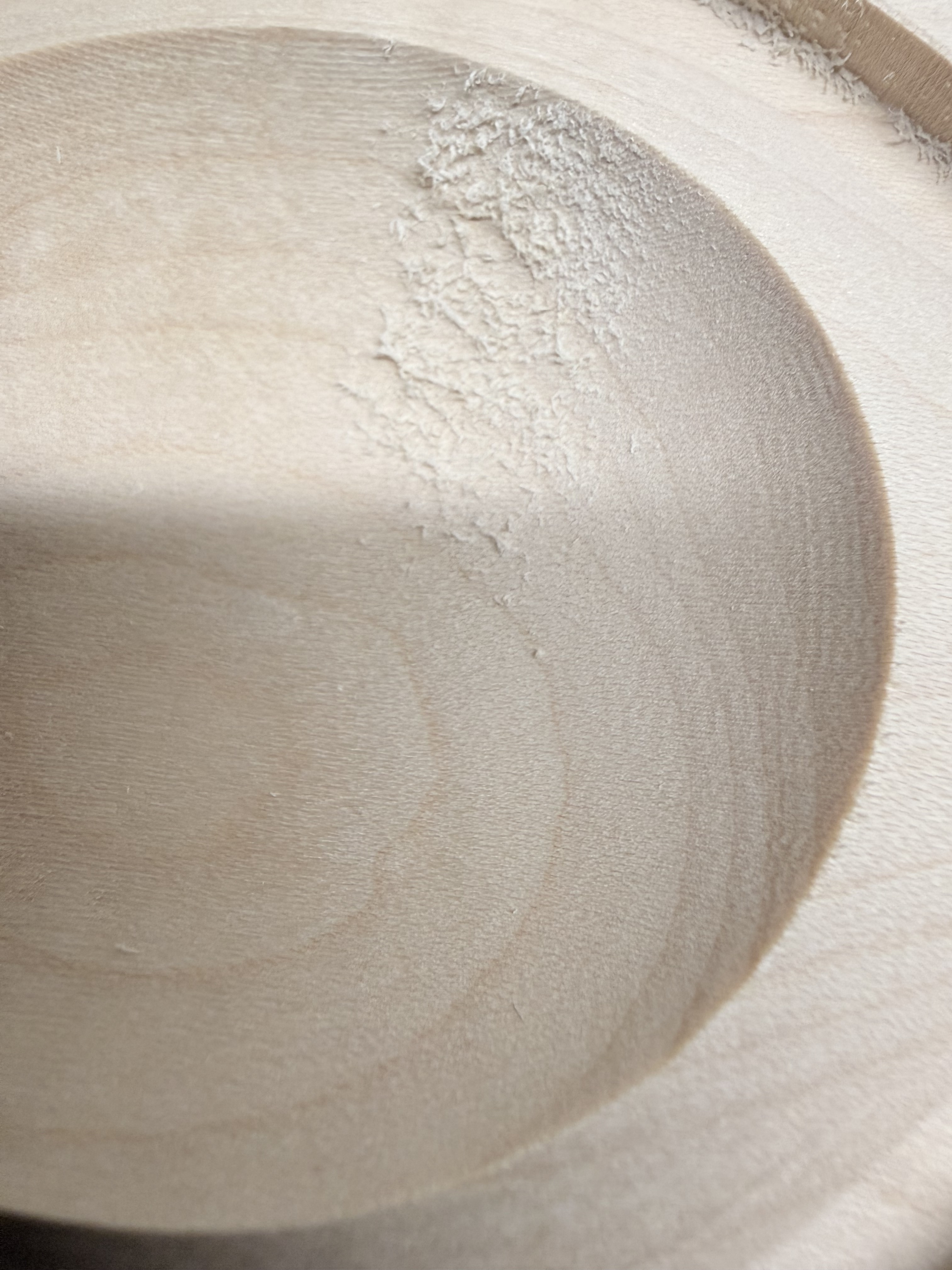
I ran a test today with hard maple. On one spoon I started with 1/4” end mill rough pass followed by 1/8” ball nose finish pass. The finish was good but there were some very small ridges that I can sand out. Not ideal but I’ll survive.
The second spoon I started with 1/4 ball nose followed by 1/8 ball nose and then also 1/16 ball nose.
Stepover for both were all 10%.
My only issue with the second spoon were two spots after the 1/16” ball nose where it left a lot of “fuzz”. This didn’t happen with the first spoon where I stopped at 1/8 ball nose.
Interaction of climb vs. conventional milling and tool rotation direction and wood grain.
For a rounded form such as this, it is actually better to use a larger tool since it will reduce the scallop height as @Tod1d has quite nicely drawn in:
What is the smallest radius in the concave portion of the spoon?
Use the largest ball you have that’s smaller than that radius.
No reason to use the 1/8" or 1/16" ball. You’re just taking way more time than needed.
In fact, try one with only the roughing 3D path with the largest ball mill you have.
Set the Stock to Leave to 0.0, and use a smaller depth per cut. i.e. with a 1/4" ball, use a 0.020" depth per cut. It should be finished after the rough cut.
If it’s fuzzy, drop your Z 0.005", Do a finish cut with the 1/4", but seal the wood really good before running the finish path.