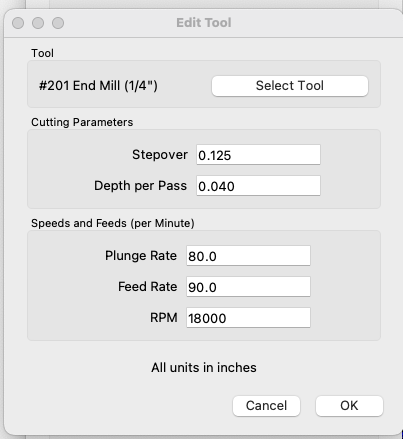
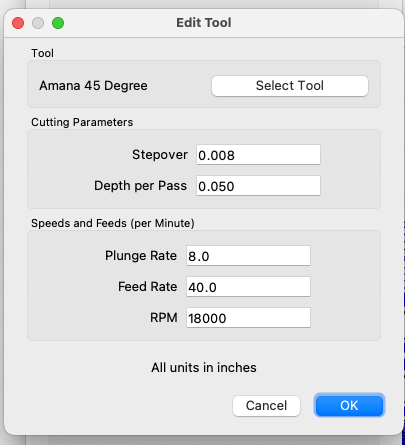
I just added a spindle to my Shapeoko 5 and using a 201 end mill on cherry. The cuts are very conservative .040 and I’m getting a high pitched squeal when cutting. The squealing stops when the spindle lifts and immediately starts when the cutting resumes.
Any idea why this is happening and how to prevent it??
What Wilson said. Share your speeds and feeds for some feedback. Also, if this is the very first time you’re running the spindle, watch it carefully when it starts spinning, to make sure it’s turning the correct direction (clockwise, when looking down from the top).
Also, general tips:
Make sure the collet is seated securely in the collet nut before installing an endmill.
Install the endmill further up in the collet (without hitting the physical limit) if maximum cutting depth is not required.
The red numbers on the 65mm spindle controller display 16,770, is this the spindle RPM? If so, as you can see from the screen shots, I have the RPM set at 18,000.
Collet nut is seated and acknowledge seating the bit higher up in the collet. The spindle is turning in a clockwise direction.
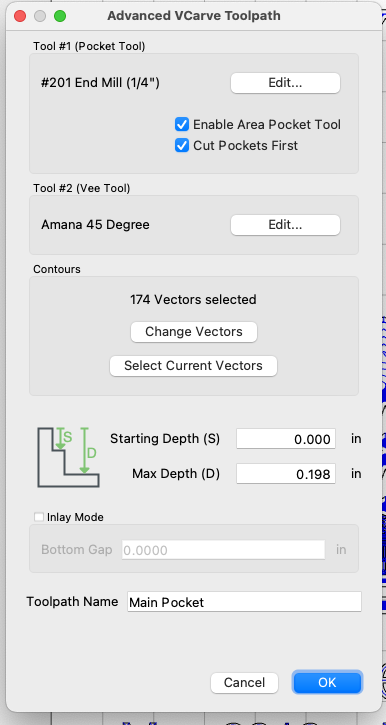
I added the Advanced VCarve Toolpath because the 45 degree bit squeals as well. I appreciate the help with this, any recommendations on anything are appreciated.
You can DEFINITELY bump the DOC up significantly. I use 0.1" to 0.125" with my #201. Haven’t used the 45 V bit all that much, but with my 30 V bit I’ll cut 0.07" per pass.
I think there’s some room to play with regards to RPM. The VFD will vary slightly (about 5%, and in extreme cases like 7-8%) because the PWM signal is analog, but it should be consistent, so it’s easy to compensate for once you get a feel for what programmed value works best. I would suggest doing a test piece with a couple different small pockets. Try 16k, 18k, 20k, 22k RPM and see which one works best for you. And you could also test different depths as well. Every setup, every material is a little different so the optimal ones will be the ones you test, not the ones the softwrae defaults to.
It is a frustratingly incomplete response, but your solution lies in doing what works for you. While our machines, tooling, and materials are similar, our shop conditions, weather, and even geography make cnc work different from one shop to the next.
As others have said, try faster and slower Feed/Speed combinations on a test piece. Pine works (sounds) different from cherry, walnut, or mdf. Take a few notes. After a some tries, you will be able to tell by ear and smell if something is wrong. Your Shapeoko is designed for you to win so you know the answer is in there.
I got better by making simple key trays with people’s names on them. Made one for the cashier lady at the local grocery store, the women at my dentist office, called one a “phone tray” for the guy down the street and simple coasters for the bowling league. All of these are quick and easy projects that helped me gain experience in using the machine. Just manipulating the collet. learning the procedure for Initialization, etc takes some time. You are on the right track.