I think I got the answer within the “similar to” - but I want to make sure:
I just recently bought the Carbide ER-11 Router. Since a number of my jobs switch back and forth between the 1/8 and 1/4" shank size - and require that I pop out the collet each time, I was thinking of getting a second collet nut and keeping each size ER-11 collet in the nut - making swapping faster, reducing wear on the collet ring, and just making things easier.
So…
Is anyone else doing that?
Does it makes sense to do that?
Where can I get an extra collet nut? Will any ER-11 nut do?
Any ER-11 collet nut should work, since it is a standard. However, nuts will come in different qualities. A better quality nut will be better balanced, and have better precision and tolerances.
The precision, run-out and balance become more important as the bit size gets smaller.
If you are in the USA, you could just get them from C3D. The collets themselves can wear-out over time, so getting the extra collet with the nut isn’t really a bad thing.
PreciseBits also comes up as a good place for tools and tool holders:
There was another thread asking if the 8MM was ok to run on the C3D ER11 router. The thread indicated that C3D does not recommend running the 8MM bits in their router. Nothing will stop you from running the 8MM but the discussion was about the extra force needed to run the bigger bit in a palm router vs a spindle. It is established that the ER11 can definitely have an 8MM collet but the question is should you run that big of a bit on a palm router. FYI
Hrumph. So, the carbide nut/collet is $25 plus $8 shipping…and I don’t even need the collet. Seems like a lot to spend on stuff I don’t want. I’ll try my luck on Amazon, I guess.
I’m far from an expert, but I did find these ER-11 collet nuts on Amazon:
$13.50 for 4, and they claim to have been dynamically balanced via drilling.
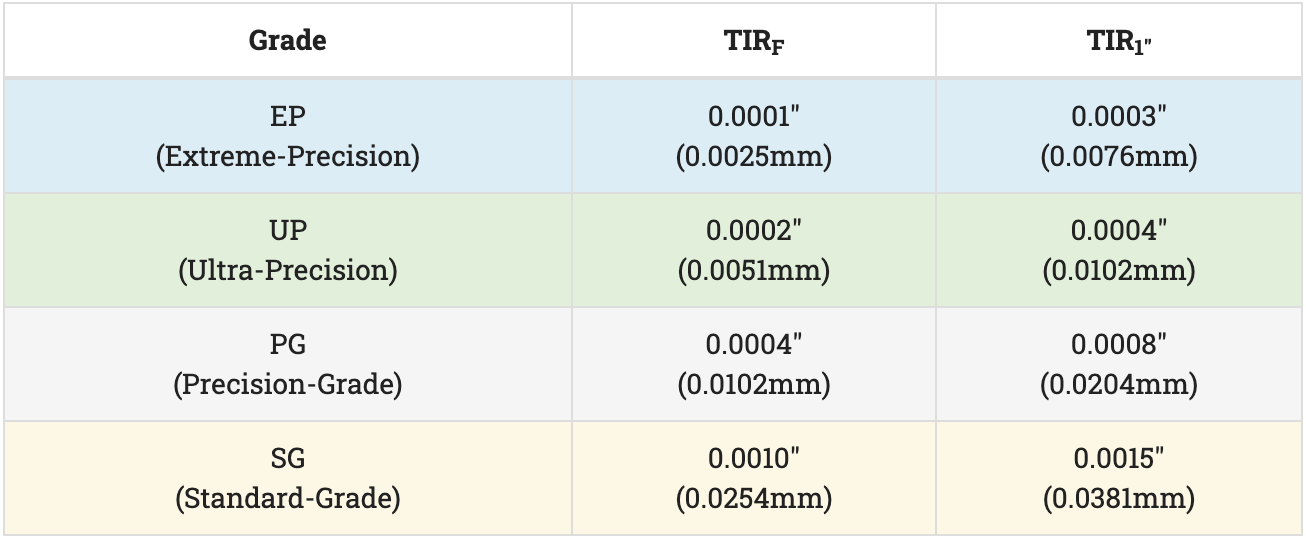
PreciseBits has this to say about what collet grades to get for wood:
Pine, fir, cedar and other softwoods: If you are machining softwood, or any other material that tends to compress during the cut and then spring back after the bit has gone by, using a collet grade higher than PG doesn’t really make much sense. There will probably NOT be a noticeable improvement in the quality of the cut using a lower TIR collet. For most projects with small tools, SG collets will probably be perfectly adequate.
Hardwood and plastic: Although most hardwoods and plastics do not display as much compression and spring-back as their softer kindred, a PG collet will almost certainly be more than adequate for most projects. As above there will probably NOT be a noticeable improvement in the quality of the cut using a higher grade collet.
Where the SG and PG grades are defined in this table:
I just received my ER-11 router last night, and in looking it and and collets over, I think I’m going to be happier than with the Makita collets I’ve been using. Even just convenience-wise, having the collet nut capturing the collet seems easier to handle. And the ER collets are more flexible and longer than the Makita collets, so they should grip better. For $60 (closeout) including two collets and one nut, it seems a steal. I’m tempted to buy a second one to use in my Makita plunge base for hand-held routing.
I think I’m going to stick with the highest quality collet I can find - but I decided to get the collet nuts that were not the cheapest, but not even $10 per. All I needed was the nut - and even that was for convenience…so, I couldn’t see spending more than 3 times that to get a collet I don’t need and shipping.
I have the 65mm VFD spindle. I bought several collets and made a 3D printed collet/bit holder. It makes the bit changes easy and was not expensive at all. It smooths the process during the tool changes.
Yes…I used the new collet nut last night and it was SO much easier than having to work the collet out of the nut detent. Plus…as an added benefit, the nut and collet both fit into the collet container that comes with the Carbide collets…so storage is easy too.
The one thing which I would like to reiterate here is that having the pre-made up collet/nut assembly can lead to one forgetting to clean, since dust will be hidden — be sure to remove any trapped dust/debris after/before each use.