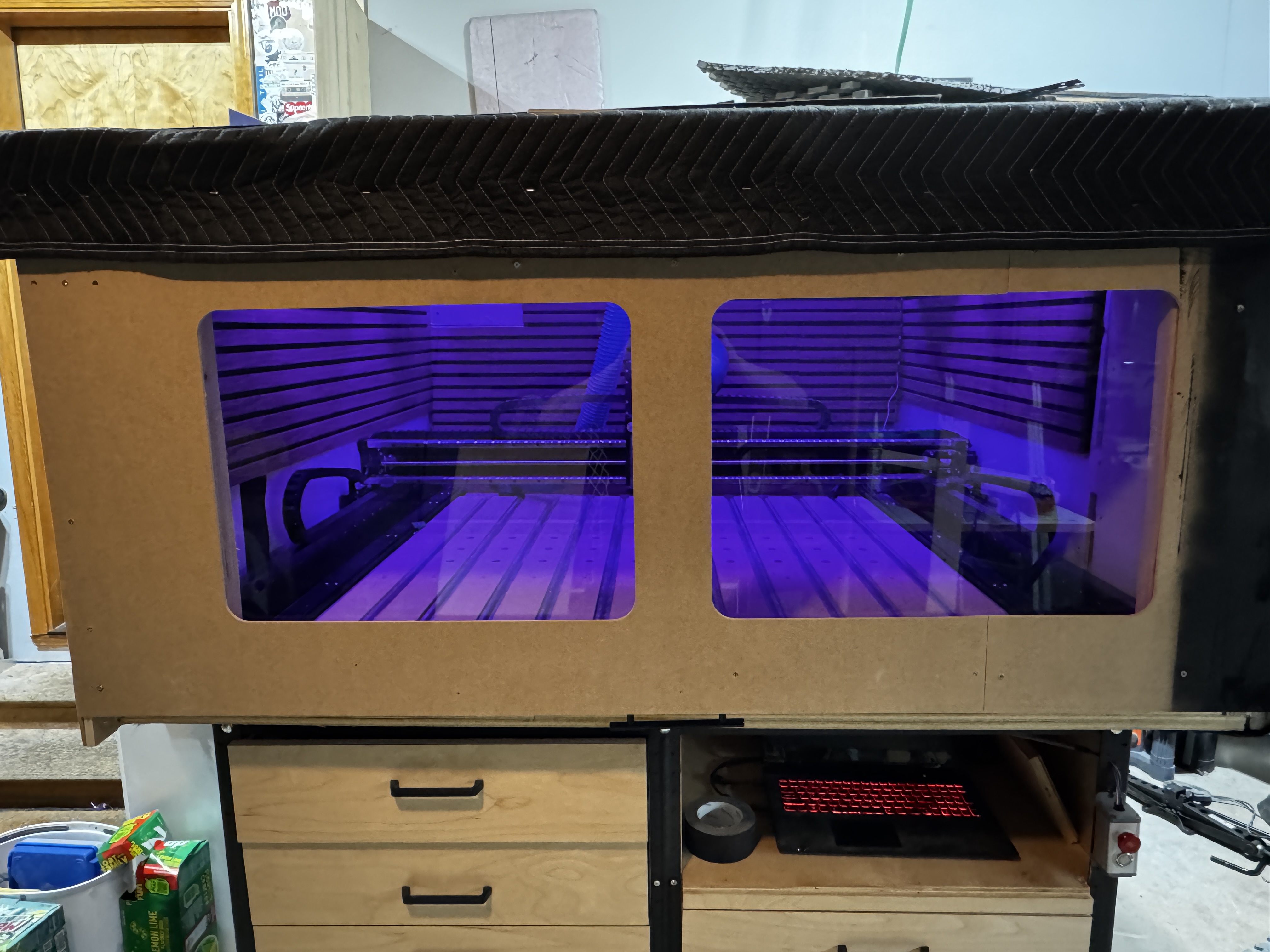
Was getting real tired of dust everywhere and the noise, so I decided to build a CNC enclosure as a side project to keep myself busy.
Most of the lumber was free, reclaimed 2x4s from a project my dad had just torn down. The sheetrock was also free from a remodel he finished recently. I was also able to use up a huge chunk of scrap wood that was filling up various corners of my garage. Project was relatively budget friendly, but wood is still pricey here when I needed to buy things.
I went through a few redesigns early on once I realized that a 16” deep door, lined with sheetrock on the inside and ¾” MDF on the outside, was… optimistic . Learned a lot along the way and adjusted as I went.
Key features:
Frame is 2x4s turned sideways
Exterior skinned in ¾” MDF
Interior skinned in ½” sheetrock
Wall cavities stuffed with cut-up workout mats I wasn’t using anymore
Outside wrapped with moving blankets for extra noise control
Lift assist on the main door — even my kid can lift it one-handed
Back wall has a flip-up door for rear access and tiling longer pieces
Table was already on heavy-duty machine casters, so the whole thing can be rolled around pretty easily still
Still not “studio quiet,” but it made a huge difference in both noise and dust, and I’m pretty happy with how it turned out.
I’m still stuck on the dust collection hose and how to stop that from getting tangled up. If anyone has suggestions I’d love to hear them.
I am looking to assemble my new 4x4 in a day or two and am considering an enclosure later. I have seen that some people are placing sound dampening matts under the base. I thought of trying some carpet underlayment. Any reason this would be a mistake?
I’ve had my CNC for about 1.5 years. I’ve used it from everything from art projects, organization for the garage and set pieces for the local ballet theater here.
If you ask my wife all I make is “things to help me make things for my things in the garage.” But I resemble that remark.
Why not use soundproof insulation in the walls? That would greatly reduce, if not completely eliminate, the noise from the machine. I know noise can be completely eliminated because I have heard soundproof bedrooms before made for music studios and once the door was closed, you couldnt hear a single thing in the rest of the house. Then open the door and the sound would blast right out as if a concert was underway.
My buddy is a radio station technician currently building a new studio. He mentioned basically needing two insulated walls with an air gap to get total sound proofing.
I doubt I’ll ever get committed enough to doing that for an exposure, but the thought entrained me.
I have tenets in the house where my shop is. They are using a corner of the shop for their stuff that they dont want in their house. I have decided to build a shed up by the house so they can move all of this stuff out of the shop and into the shed. This will open up that area in my shop. That room is 10 feet by 16 feet with partial walls up. I would like to finish that room by fully inclosing it, soundproof, and venting outside. This way I could move my CNC mill in there into a built encloser. Also can build platforms for 3D printers and even laser engravers.
The walls are not finished, so I can build the double wall with soundproofing material between the walls. This will eliminate the sounds of these machines, and to reduce dust contamination from the wood shop into this area. Dust is a constant problem in the shop. Everyone deals with this Im sure, but I cant have dust getting into the 3D printer and screwing it up.
Anyways, the spoudproof walls would be great for any noise reduction. It takes a bit more designing and building, but worth it if there is a bunch of other things adding to the overall amount of noise in the shop.
Have you thought about those noise dampening tiles that can be installed on the inside walls of your enclosure? They might help more then a full encloseure rebuild. They would reduce echoing sounds bouncing off the walls.
The outside panels are easily removed and I may end up putting some soundproofing in the walls at some point. The goal right now was to try and spend the least amount of money and the soundproofing i could find were expensive, or more expensive than I wanted to spend right now.
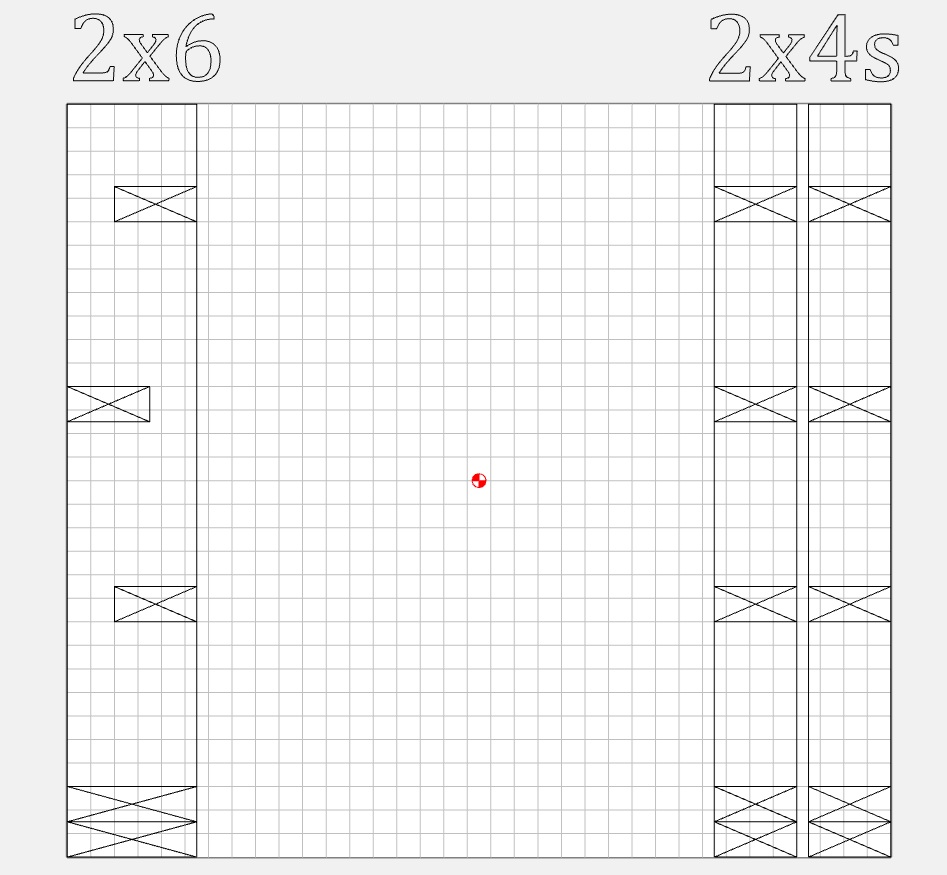
2x6 walls with offset 2x4 studs. Then you run insulation weaving between the whole length. It’s cheaper and 90% effective.
2x4 double walls. You still need to insulate between 2x4 studs on both walls but you leave an airgap so they never transfer sound. Costs more, more work, 100% effective. Sounds like a solution that’s too effective for our problem.
The 2x4 double wall design is actually the best design for sure. The work around for the surround be still cost effective because you wouldn’t be using so many 2x4s as you would think when turning them sideways. Of course this design you have modeled would mean the wall would be at least 7.5 inches or more wide. The way I am saying to turn them, as per the statement from earlier about them being turned, would make the wall around 3.5 to 4 inches deep.
The 2x4s could be ripped long ways into 1.5 inch by 1.5 inch strips and the 2x4 studs be turned and put on top of them. This would make a 1.5 inch thick wall then add about 1/2 inch gap, then add a second wall the same thickness. This would reduce the full wall to 3.5 inches and the soundproofing should work really well.
If you are restricted in the thickness of your walls, then there are work arounds that could be done, but the result that one is trying to perform is to make a barrier for soundproofing material to be installed between the two compartments.
Just my two cents. I have my enclosure in the basement, next to my camera gear so it was necessary. I have a large shop-vac built into the underside of the enclosure with ducting coming down from the machine enclosure and a hose for dust collection. For the vacuum enclosure I lined it with fire resistant floor padding. There are vents for air intake and blow out so I built baffles to reduce the noise from those. The machine enclosure is 1/4" clear acrylic all around with a plywood frame. The noise is quite acceptable.
I don’t think you want total noise reduction because I find if the machine has issues, I hear them first. I don’t want to sit on top of a project that is going to run for 2 hours, so I work at my desk 20 feet away. You get accustomed to what the machine should sound like, so I can tell if it is struggling or stopped all together.
Yes, machine noise is important. I have learned with metal machining that tools make a certain sound and when an insert or endmill chips, the sound completely changes and that is when I know I have to pay more attention to the machine.
I was training a new guy on the lathes some many years ago and we had the machines running. I heard the very slightest sound change and told him the insert just chipped. We stopped the lathe and checked that particular insert. Sure enough the leading edge was chipped. I replaced the insert and restarted the lathe at a restarting point in the program. The new guy asked me how I even heard that the insert was chipped? He said he didn’t hear anything different. I explained that I was attuned to the sounds my tools made and the slightest change meant that the tool chipped. We had surface finishes that were needing to be held. So, running a chipped insert all the way through the cutting would have scrapped the part, or maybe made some of the next tools coming up to also chip or break.
I like being able to hear some of the sounds my machines are making to know how efficient they are running. I hate changing out saw blades and such, but know they have to be changed after so long. Wear is wear and when a tool is worn out, it needs to be replaced. Then I want to resharpen the bits or blades, but not worth it sometimes. Once I toss them into the recycling bin, I can finally release my hold on them mentally and move on.
 . Learned a lot along the way and adjusted as I went.