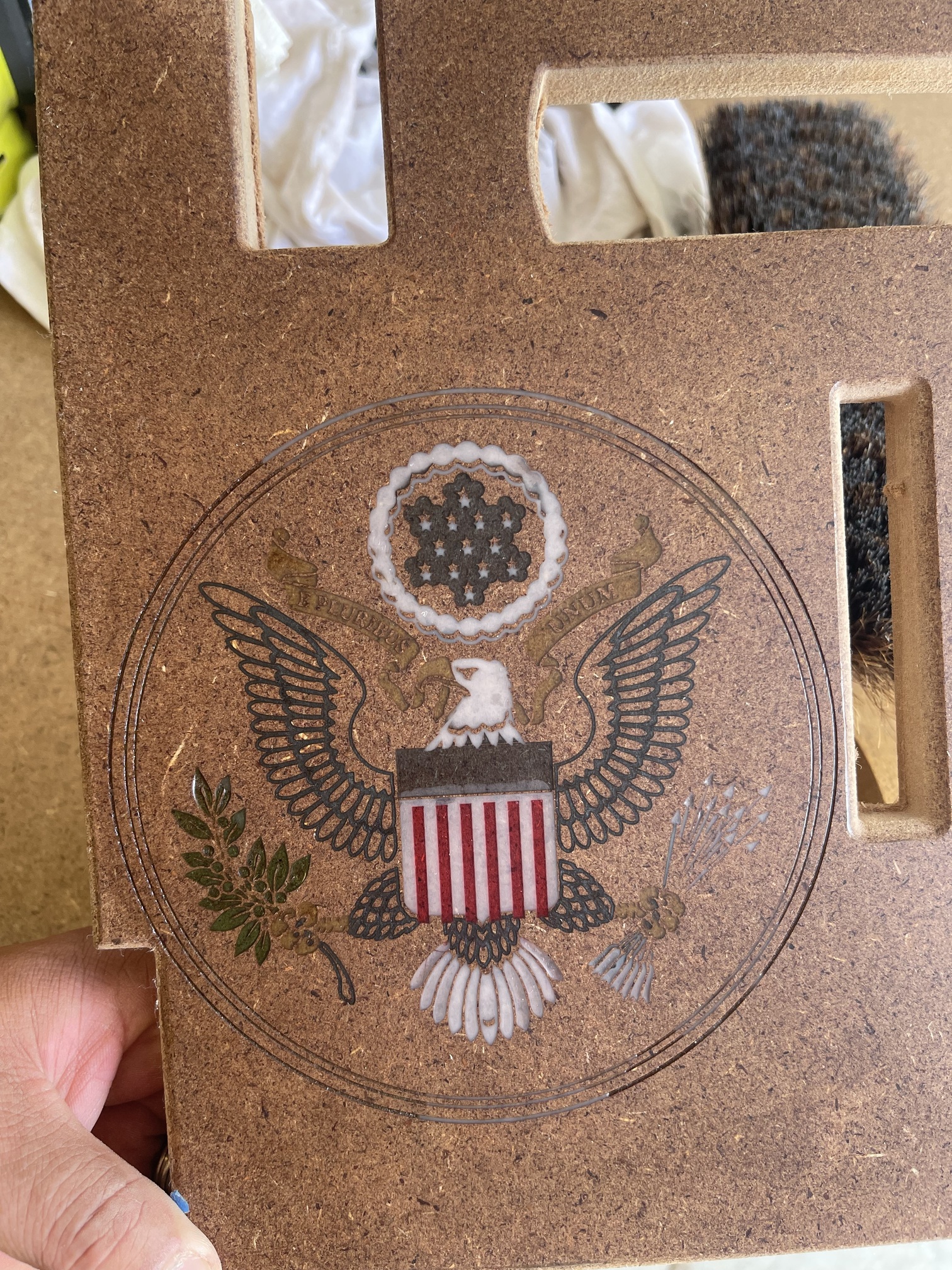
I was tinkering with the thought of using some epoxy for a transfer gift for someone. The customer wants the colors of the Great Seal of the USA in color and instead of disgracing the walnut lumber with some rattle cans I was feeling a bit ambitious after doing some wood inlays. My idea was to try my hand at some epoxy inlays.
I am having trouble wrapping my head around a work flow or the most efficient way to get it done with as close to as much detail as possible. And keeping the “brown” for the bird as just a basic contour with no offset type engraving. The one part where I have some fudge factor is that the seal will probably be about 4” in diameter so I know the detail won’t be as intricate being so small. Any thoughts or advice, please Send It.
This would be pretty darn finicky to do in epoxy. You’d need to carve and epoxy several time in succession, so you need to either leave the stock on your machine while you epoxy, OR have a way to repeatedly remove and re-position the stock.
You also have the problem that you have adjoining areas that are the same color. For example It will be tough to separate the head of the eagle from the background. Same with the beak and ribbon, and the different sections of the ribbon.
The details will be more intricate, finer on a smaller dia cut.
To leave the brown as bare wood, I would coat it with a layer of clear epoxy first.
Then work outside → in. Starting with white, I would do the entire area in white, then cut the other colors, yellow, blue, gray, red, green, black into the white. And then the lines in the eagle into the clear.
You’re talking a full day of curing time for each color. You could do several colors at once, for example yellow, green & red.
It will be a challenge to get a good solid opaque white over walnut. Consider spraying the white section with a coat of white primer before pouring the epoxy.
How big would this be? For a wall hanging it would likely be possible. If the size of a challenge coin impossible unless you simplify the design. Even painting would be a painstakingly difficult feat. However improbable success you wont know unless you try. Sometime you have to fail to succeed in the end.
If you choose to use epoxy use table top epoxy. Most table top epoxy can be poured to 1/4" deep. It dries in 24 hours to the point you can machine it off.
@mhotchin mentioned repositioning and he has a valid point. Maybe a couple of dowels through the project and into the spoilboard would help reposition your project precisely. Pouring epoxy on top of your Shapeoko would not be a good idea. Just make your project big enough to cut off the dowel holes when finished. Homing is another point that varies from power on to power on. With a project as intricate as this a few thousands could cause issues. To avoid this move off your cutting area but on your substrate and make a mark. After initialization jog to that point and write down the coordinates. Then you have a reference point for subsequent initialization. Move to the written down coordinates and jog down with a vee bit to see if you are on target. If not jog until directly over the reference and not the new coordinates and adjust your zeros accordingly. Or just re initialize until you are back on target. Homing works but can be off a few thousands on each initialization.
Sorry yall, I went rogue for a bit. So I did run the file and made the design significantly bigger. Everything was descent until the last run and I am unsure how it happened lol. My trial I finally got the image to upload fine with AI help with this image and some node edits. My last run after I left the epoxy on to cure I attempted to do the white stars for filling, and the red stripes along with the white tail on the tool path because I hadn’t figured out a good flow for incorporating the red and white stripes. Overall it was a descent run. And a learning experience. I did have some bleed over from the white to the blue due to my impatience.
Yeah I see what you are saying. I did bump the table while off and the gantry moved back is the only way I could possibly explain what happened on the last run which may have caused this homing to be off. But with the final piece I will not have the center as over this image so I would be able to find my center again once runs are complete. Once my center of the shield was cut I was kinda of riding blind and just hit the I Believe button and sent it.