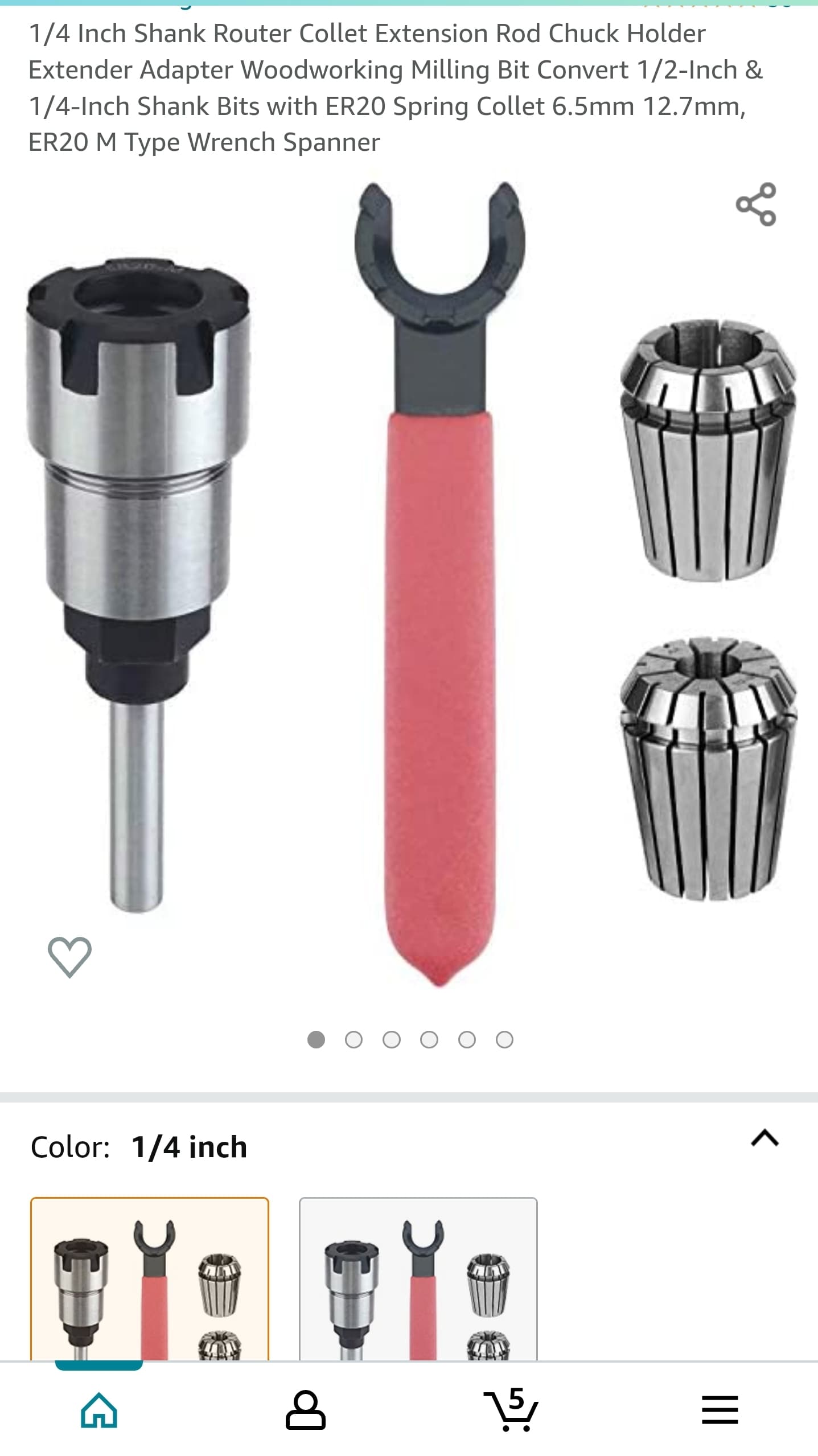
I’m curious if these ¼" to ½" adapters are safe to use with a C3D spindle? I’m just curious about the forces that are exerted on the machine and such?
The reason I’m asking is that I have been looking at some different bits, but they have a ½" shank on them. Nothing like a big 2½" cove cutting bit, but rather a dish cutting bit with a ½" shank and a ¼" radius.
Some folks have done 8mm → ER-16 adapters — when well-made and balanced they seem workable for tooling w/in reasonable speed (RPM) limits — that said, they’re not supported.
The adapter in question might be useful for metrology — if one has a dial indicator or tramming gauge which has a 1/2" shank, but that’s all that suits to my mind.
The bottom line is, 1/2" tooling is a lot of mass, and requires a great deal of torque — if it were easy to spin such tooling so as to cut effectively, the just announced Carbide 3D VFD Spindle would be ER-20, not ER-11 (and it’s telling that it’s not ER-16) — c.f., the 80mm diameter spindle on the Shapeoko HDM. Similarly, look at the motor rating and diameter of all the full-size routers which accept 1/2" shank tooling.
I have a spindle with an ER20 1/2" / 12mm capable collet in my machine, I use 10mm, 12mm and 1/2" tools in it, but these are generally things like edge finders or tramming gauges, rather than large cutters.
I wouldn’t touch those Amazon / eBay wobble increasers with a barge pole, out of balance things in a high speed spindle are not nice.
In terms of the cutters though, trying to find a cutter which exactly matches the profile you’re looking for makes a lot of sense with a hand router, because making composite shapes is hard. This is particularly true of the moulding shape type bits.
In a small CNC it’s frequently the other way around, we frequently design toolpaths to avoid heavy engagement points where too much of the cutter is cutting the workpiece as this tends to cause vibrations and deflections. With a CNC it’s frequently faster and easier to use a cutter with a smaller radius than your finished model and walk down that radius in a few cuts, moving the cutter faster through the workpiece with less load.
Exceptions to this are things like dovetail cutters where the precise angle of the bit is important to us, but still, it’s common to clear out the bulk of the waste with a smaller straight cutter first.
Usual preface, I’m with PreciseBits so while I try to only post general information take everything I say with the understanding that I have a bias.
This actually gets much worse than just the base imbalance in the adaptor. Let’s assume for the sake of argument that the adaptor is perfectly balanced. The problem is that that perfect adapter now has to be mounted to the spindle/router through a collet. The error of that collet and spindle/router taper are now pushing the adaptor off center creating a new imbalance and load. Now we add a tool to the adaptor with another collet and (in the worst case) add the runout of the adaptor shaft, adaptor cone, and the runout of that collet to the tool. That total can be extreme even for the bearing stacks in decent size spindles. If this is skew runout it also gets worse the further from the runout source.
The above also doesn’t address the load you are putting on the bearing and adaptor by then cutting with it. Even with everything being perfect (runout and balance) a 1/2" tool puts a ton of force on the system (and the tiny 1/4" steel shank of the adaptor). You can approximately calculate this with the cubic material removed per flute per rev. But the short version is that that you would have to take a VERY shallow pass.
Now add back in the runout issue. Assuming that you are using multi-flute tools you now have to add all that runout from all those points to your chipload functionally increasing it. Alternatively your runout may be higher than your chipload moving the entire cut into a single flute (this gets more complicated with more than 2 flute).
In industries that actually use collet extensions in production, the number I usually seen thrown around is no more than 0.0002" (0.005mm) total runout being acceptable.
Even in the HDM I only use 1/2" tooling for light surface passes of ~0.020" and that v is mostly to get a shinier surface finish. 3/8" is my go-to for removing material… and I still often go with 1/4". 1/2", as pointed out generally doesn’t have an advantage unless you have a BIG, powerful machine.
Thank you to everyone here that took time to send input. I do appreciate it.
That is what I thought. I was just wondering. I realize it takes a lot of horsepower to turn big bits as well as the forces and stresses it puts on the machine, (not to mention when the bit isn’t razor sharp with using).
Also I realize it eliminates a lot of the Z travel.
Remove the bearings and they’re usable as CNC bits.I ended up mostly using the middle one, as the flat bottom prevents ridging while still allowing good sized stepovers.