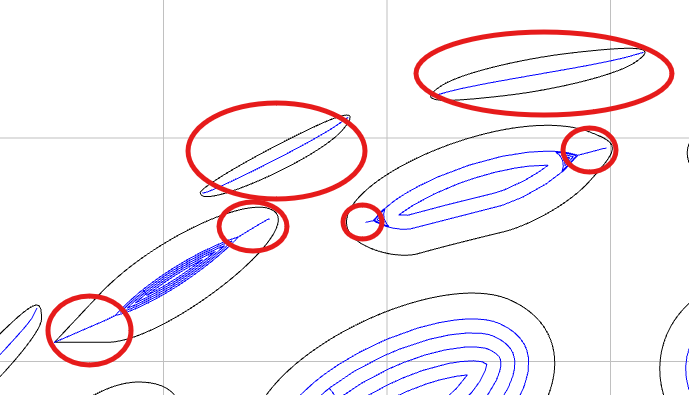
I found this graphic and converted it to svg. I want to create an inlay and have not done it in quite some time. I know there have been many updates to inlay. Please take a look at my files and give me any feed back on how to proceed.
I notice the pattern is not centered on either side. Is that intentional?
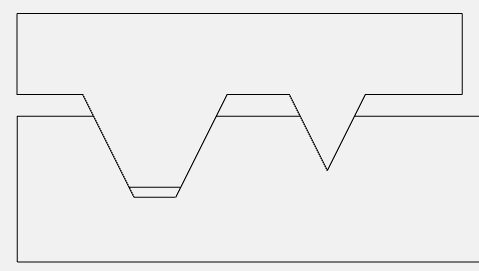
Your male side has a plug depth of 0.0, and a top gap of 0.200. In theory the male should not fit into the female at all, and rest above it. However, if there is any slop, runout, backlash, it will actually fit, just by a little bit.
You could try cutting it this way, and fitting the female to the male and measuring the actual gap.
Use this to calculate your ‘fudge factor’, or the number you want to subtract from the plug depth & add to the top gap to get the fit you want.
If it doesn’t fit well enough to get an accurate measurement, try a second cut at something like Plug Depth 0.100, and a top gap of 0.200. Then repeat the fit & measure.
I think you are ideally looking for something like Plug Depth 0.180, Top Gap 0.<something greater than 0.0>. If you band saw the plug, then 0.200, if machining it, 0.050 is plenty.
One other thing to consider, anywhere the V-carve is not clearing out the max depth, you will get a sharp edge on the male side that eliminates the glue gap. You may want to sand the sharp edges a bit to allow it to compress into the female pocket.
The image was the first one I found. For the actual project I will find a better one. I did mirror the image because it is not perfect circles in many places.
Thanks for the advise. For most adv vcarves I use 15 degree vee bit. For inlays is it better to use 90/60 degree vee bits?
I had seen a similar image made into a cutting board on YouTube. It interested me.
I’m not aware of the advantage/disadvantage of using a different angle V-bit. I’ve only used 90° & 60° bits so far. I imagine the ‘fudge factor’ is going to be greater with a 15° bit as it will be easier to compress the wood at that angle. But that may also allow for a tighter fit as the plug compresses into the pocket. ??
As for quality of images. Sometimes imperfect can look more handmade, less mechanical.