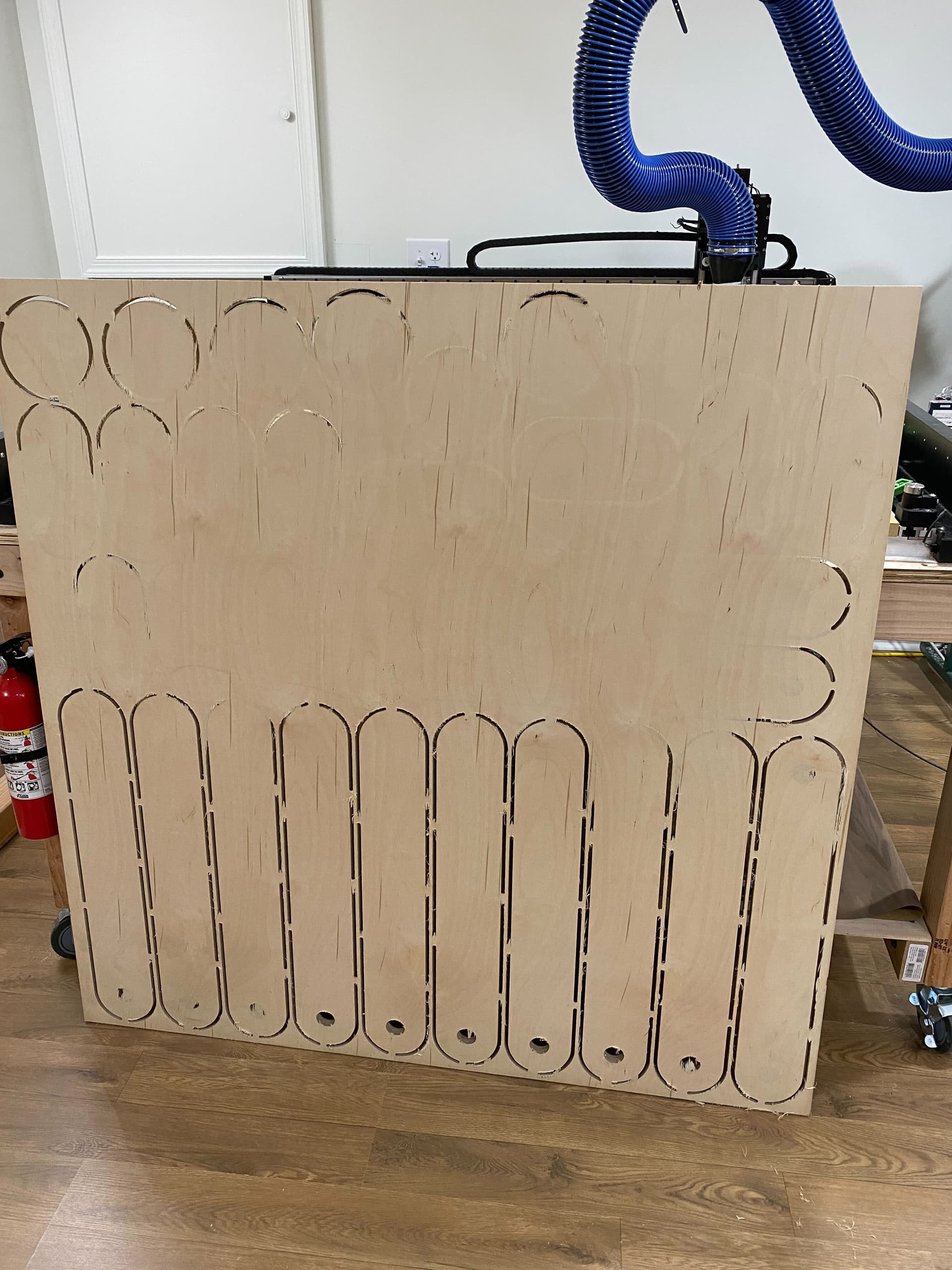
Newly set up 5 Pro. Haven’t done an initial surfacing (brand new to the CNC world) and wasn’t sure if it’s a 100% necessary. This picture is the result of cutting almost exactly to thickness (0.723") on some baltic birch. You can see some outlines of the shapes that have some onion skin and other section that cut all the way through. I’m not sure if this would be due to a slight bow in the board or if it’s a tell-tale sign of needing a spoilboard surfacing.
If I do need to, can I do it with a normal 1/4" up/downcut bit? I don’t have a surfacing bit and not sure if it’s just a “nice to have” to speed things up or not. Any CC design that would be best? Large square pocket toolpath @ 0.01" DOC?
I learned this early:
“It’s okay to scratch the waste board!”
The amount of sanding you have in front of you to clean all of that up will make it easy to remember to cut thickness of material plus eight or ten thousandths.
@WillAdams already answered but once that is done I’d suggest the following. If you are working on a part that you will cut all the way through your stock I’d suggest also zeroing Z axis off the wasteboard. This way if your stock is not perfectly flat (some minor variance in thickness) on your last passes where Z = 0 you’ll be through your material.
Basically I go by this
I’m cutting out parts, zero off the spoilboard
Decorative feature on a surface, zero off the top/surface
This finally clears up a question I had about the z zero. Is there a way to use the bitzero for zeroing off the spoilboard? I assume the bit zero is always placed on the edge of the stock.
Place the BitZero on the spoilboard and probe for Z only.
If you’re also setting X and Y using it, you’ll either need to do one axis at a time (order won’t matter), or probe at the lower left corner for all three axes, then re-probe for Z.