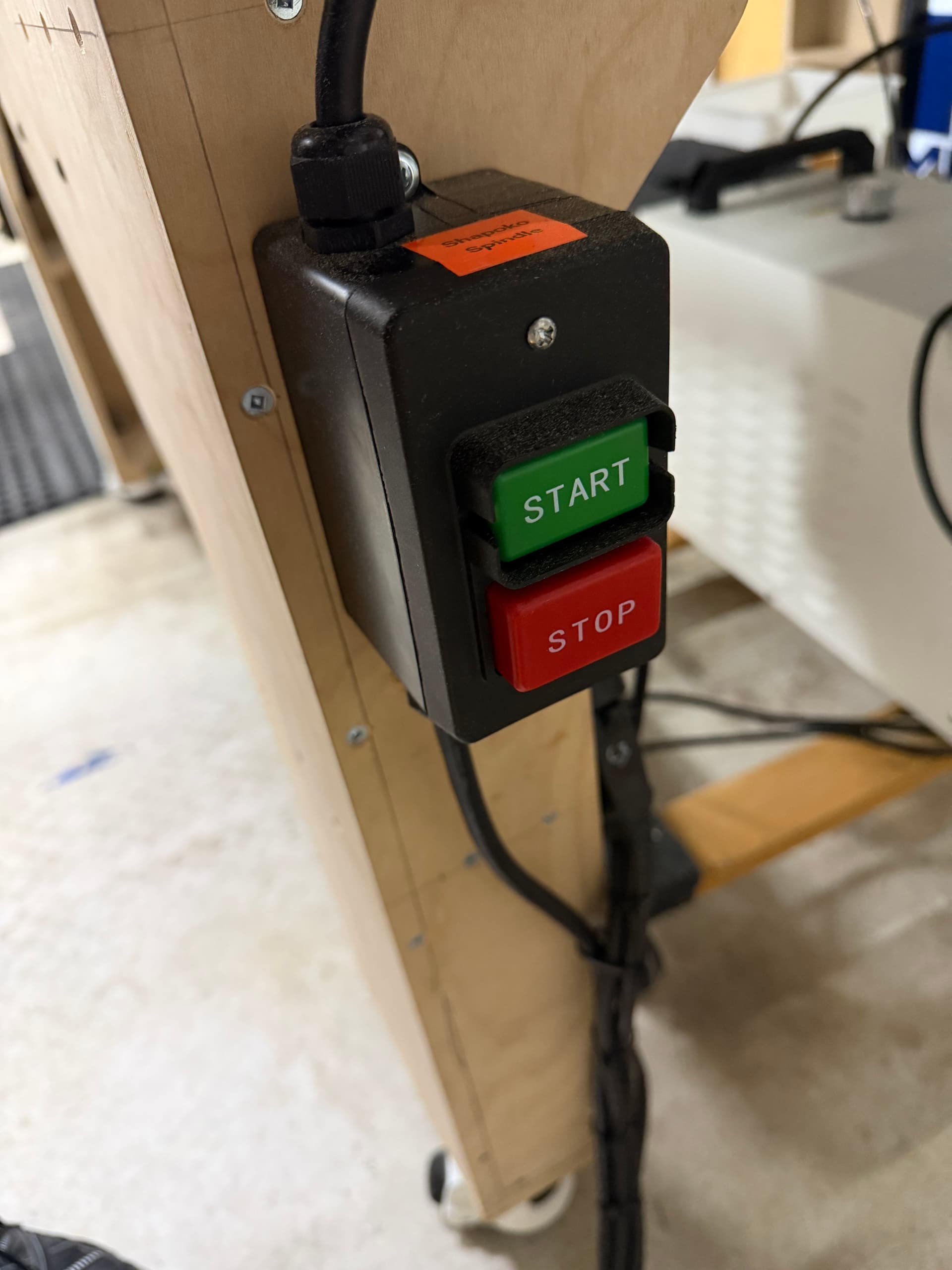
I wired the spindle cord into a switch and extended it. I mounted the switch in back on the right side as it is easy to get to.
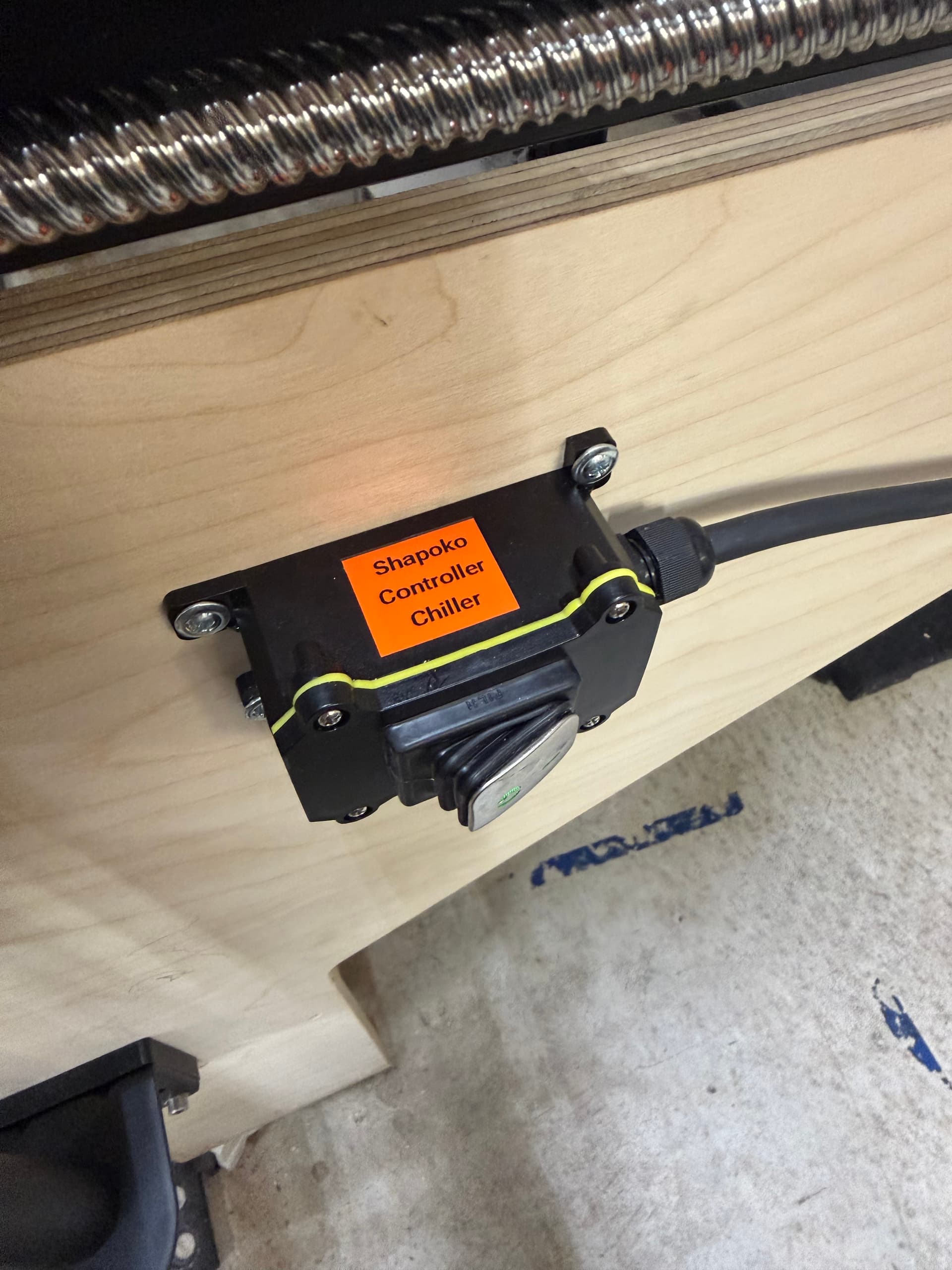
Wired remote switch that controls an outlet for the chiller, and controller
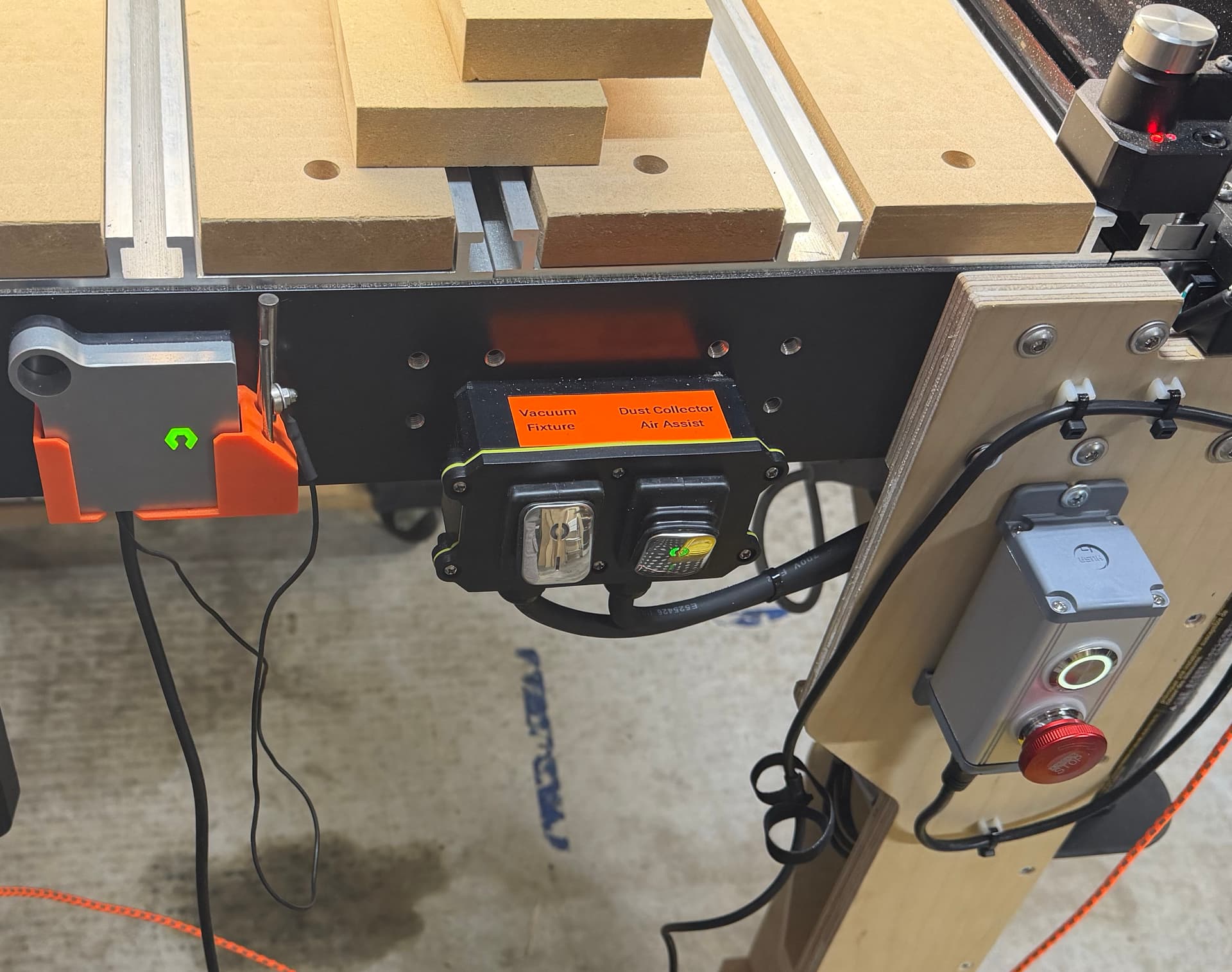
Wired a remote switch that controls the dust collector, and a chip blower.
Wired a remote switch that controls the vacuum pump.
It works well for me. For those of you that don’t want to physically wire switches they make premade ones that plug in between a power strip, and the wall. Search for piggyback plug.
I have a Dustright 1250 CFM dust collector, that I pulled the remote board on, and put in a manual toggle switch.
Next step is surge and brownout protection while the machine is running - the good thing is the amp draw is not bad on either the 110v or 220v side - the bad thing is I’ve not found a low cost battery back up that could supply the 220 v at a decent cost.
Unfortunately, it is the surge current that prohibits most of the battery backups systems. Might be looking at Musk Grade Powerwall to achieve it. The running current on a 2200 watt spindle is a simple 10 Amps, but the surge is several times that. Even frigs and freezers require a major battery backup system to start the motor even though running is only ~120W. Home central air require a 16kW generator to kick over a 2.5 ton heat pump.
If you find something, I would love to hear about. We have voltage drops and surges here because we are at the end of miles and miles of everyone else bumping the system. For a while every weekday at 9am we has a second long brown-out. Util company said they were trying to chase the problem which continued for a couple weeks. Lightning is a big risk here. In last 2 decades, 8 strikes within 200 yards of my house, 3 within a 100 yards.
I should have been more specific: I’m considering battery backup for brownouts and momentary power interruptions, not because I expect a large motor-starting surge.
Surge protection itself is much simpler to handle with a properly installed whole-panel SPD. When the CNC is not being used, its VFD is normally isolated at the breaker or disconnect, so my primary concern is a voltage drop or momentary loss while the spindle is running.
A conventional heat-pump compressor and a VFD-driven spindle are not directly comparable. The VFD ramps the spindle up and limits motor-starting current instead of applying full line voltage to a stationary motor. Also, 2,200 W ÷ 220 V gives 10 A ideally, but the VFD’s actual single-phase input requirement must come from its nameplate or manual.
If battery support is used, it needs to be a 240 V pure-sine—preferably online double-conversion—UPS approved for a nonlinear VFD load. Its continuous and overload ratings must be based on the VFD’s specified input current. The required battery capacity could be modest if it only needs to bridge a short interruption, but the UPS inverter still has to carry the full operating load.
We also get a lot of lightning strikes in this area and when I hear thunder or see it on the radar I just shut everything down and wait for it to pass, that will work for now.
I received my remote today from Penn State and experimented with it and the VFD. So far, it’s doing what it’s supposed to do. My only wish is that they would have put some kind of indicator light on the box to serve as a visual aid if power is off or not. A couple of times, it didn’t turn off for me, but I may not have been within a line of sight and/or just too much interference between me and the control box. A visual indicator would let you know quickly if you indeed turned the unit off.
The VFD Controller power indication scheme is NUTS. Terrible, really. Or maybe I’m inept. The lights are on at times when the unit is off… It’s very confusing. I also think it stays lit for a period of time after the power is off - and there’s something about it knowing if the Carbide controller is on also…lights are not indicative of just “on/off”. Or so it seems.
You could put an indication light in parallel with the VFD Controller and hang both off of the remote plug. I’ve thought about doing that, but haven’t gotten around to it.
Anyway, I’m glad it’s working for you. As I said, I’ve had it for a while now and haven’t encountered any glitches — but yes, it was initially confusing.
BTW: I believe the switch is not line of sight dependent…it’s an RF connection - it will work through walls. I’m not sure why you turned it off and it didn’t turn off…unless it’s that light that stays on after the unit is powered down?
You got me thinking about this … and I realize that I do still wonder when I push the button. Most times it works…but you really can’t tell. So I set out to fix it…
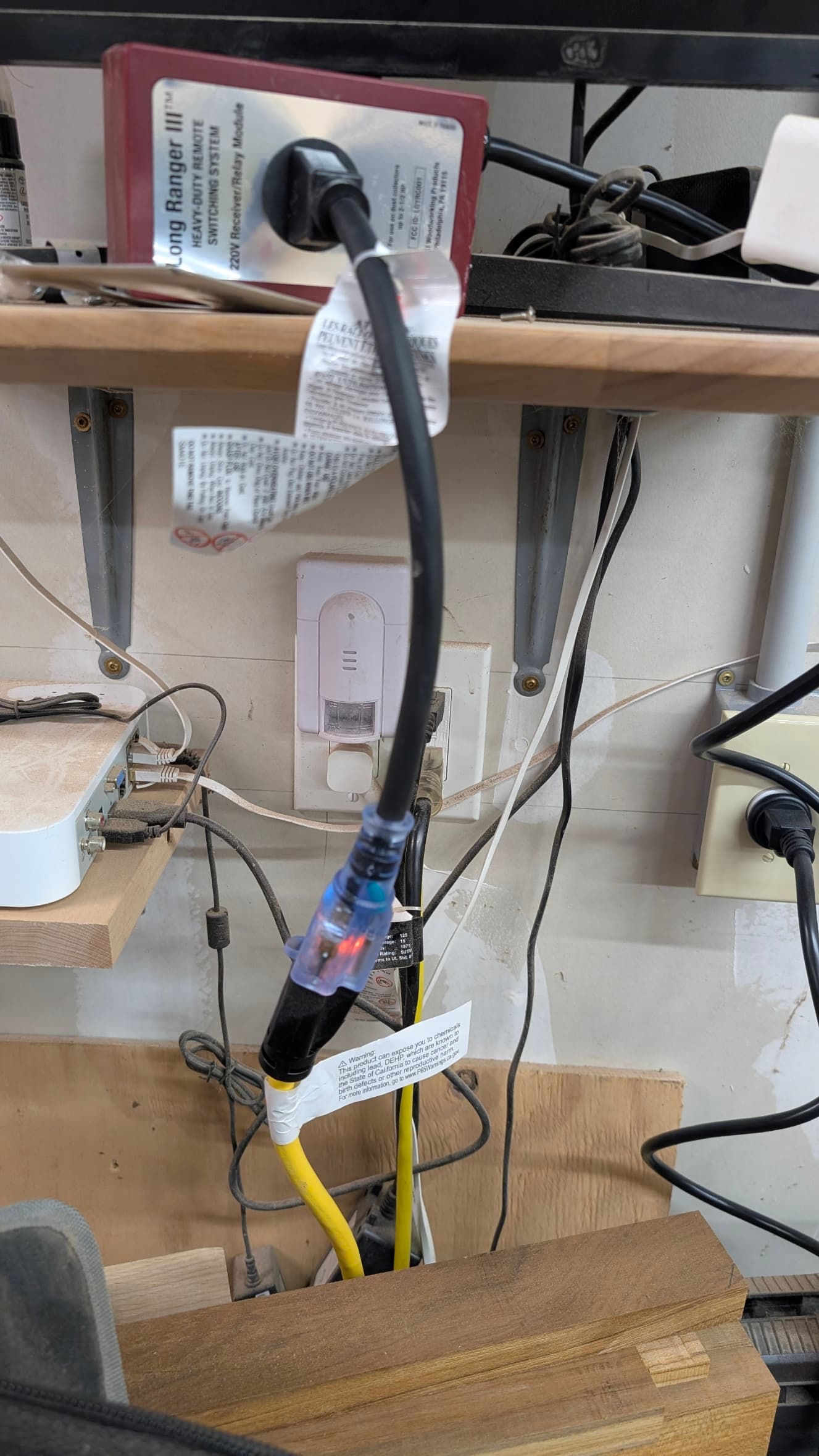
I just ordered this from Amazon…I’ll be able to try it out in the shop on Monday. I’ll hang it straight from the Long Ranger receptacle and before the adapter to the VFD. The Long Ranger receptacle is in a place where I should be able to see the indicator light that’s built into the cord - and should only be lit when the Long Ranger is powering the unit.
@scienceguyroy OK…Got the new cable and tried it out - it works GREAT. Plug it between the LongRanger and the adapter for the plug…I got a 1 foot cable, so it’s visible right next to the Long Ranger receptacle. You know it’s on when the clear plug glows red…
Thanks, Gary! I went ahead and got one, too. Seems like it’s what I needed (although, I’ve only used it one day).
I am still seeing some “failures” when I select “Off” on the remote - maybe 10% of the time. I thought it was a line of sight issue, but as you pointed out, that shouldn’t be an issue. So, I’m not sure.
I completely agree with you about all the lights on the VFD and trying figure out what they mean.
I had something interesting happen. I was testing the new remote. I turned the VFD off with the remote and then turned on the spindle. Much to my surprise, the spindle spun up but only for a few seconds. Odd (at least to me).
I’ve used a Long Ranger III with my Industrial dust collector (220V 20A) for many years…and sometimes I have to press off more than once…although, I actually realized I was pressing ON again, when I thought I was pressing off…so some of those “failures” were human error.
I bought a Clear Vue cyclone years ago that came with a 110 relay that would turn the 220 on/off. It was controlled by a remote from HeathKit but I had tons of issues with it. Something would cause it to turn on without me being anywhere around so I added a toggle light switch with an LED indicator and 110 outlet which the heathkit receiver was plugged into. When I left the shop I would flip the switch.
Eventually I replaced the HeathKit stuff with an IVac system and never had trouble again.
I understand what you’re saying, but I was using the instrument today and continued having issues even paying close attention. I may reach out to Penn State.
I believe you can change frequencies (or channels) on it…a set of dip switch settings…which is designed to allow you to have multiple controllers for one switch, or multiple switches in the same room. Maybe there is some interference and changing one of those settings will make a difference? The folks at PSI ought to be able to help you out.
 Very cool!