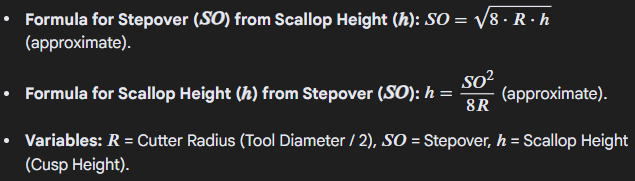
I’m no expert but I try to stick around 8%. Anything less takes forever.
Sometimes I will do a second finishing pass at a different angle if the project demands and I can stand the time. Not always though.
Interesting, I don’t recall seeing that “Clearance Pass Stepover” before but I see it now in the settings for a TBN, weirdly not on my other ball nose bits though.
I have it set very high, like 45% but then again, I don’t think its really in play in my carves. I typically have multiple ball nose or TBNs defined in the tool selector for the 3D finish paths.
I use 10% for all my finishing pass settings. Mostly because the math is easier
I’ve never done two passes since the first one normally gets me the finish I want and I try to go with the grain since it may hide tooling marks better.
I run a 1mm TBN @ 20% stepover. 20% of 1mm is imperceptible, and it still takes a long time. I would reduce the stepover to 8% on a .25 ball mill. This using a raster strategy at 45% angle to a previous roughing pass.
In my experience, on softer woods, two finishing passes does improve the finish if you leave a small amount for the second pass. I use the ‘Stock to Leave’ setting to leave about 0.10 to 0.25 mm for the actual final pass. The second pass can have an increased RPM and feedrate - I’m moving at 4000mm/min (or more) on the last pass.

 … so I can change the stepover in the tool selection settings window