I’m a complete noob so forgive me if this may look very simple but I’m trying to figure out how to design cutting board feet made of Walnut. Please see attached pictures. I’m struggling with how to design the tapers.
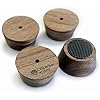
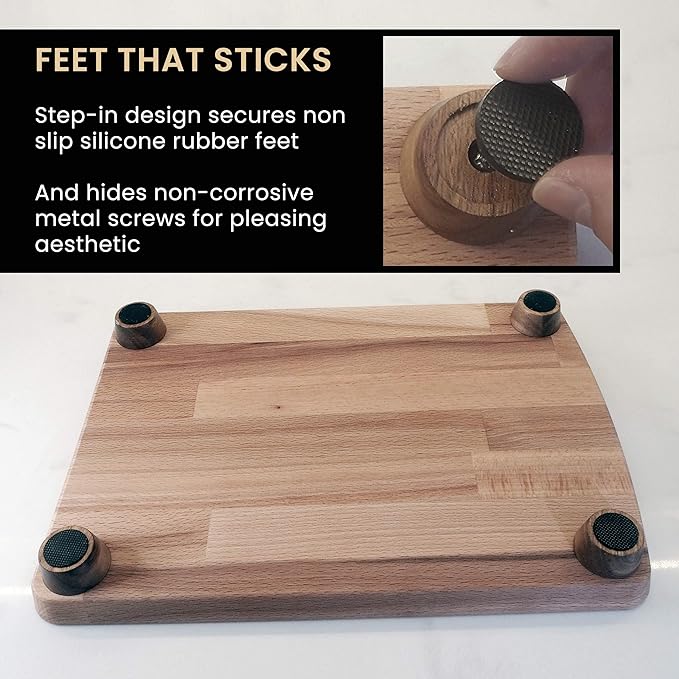
Draw two nested circles, set up a V carving toolpath with a suitably acute V tool?
Do a perimeter pass with a V tool which matches the desired angle?
stupid question Will, what v-bit do you recommend based on the picture above? Would you say 60 degrees?
I believe you will want a more acute tool than that.
We sell a 30 degree tool:
but it’d defined as an engraver, see:
(but note that you will need to test feeds and speeds and so forth carefully)
3 Likes
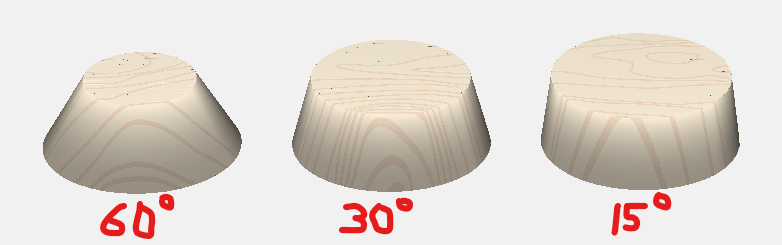
@Tod1d gives some good examples of various angles. However here is some free advise. The feet are on the bottom and no one will be looking at the feet. So why not just have straight walls. If you want a pocket to put your gripper pads a straight wall would look just as good and take a lot less work. Some times we cannot see the trees for the forest.
Which ever design you go with use stainless steel screws. You should not be putting a cutting board under water or in a dishwasher but it is subject to getting wet. A regular steel screw will be hidden from view and might just rust away over time.
Most cutting boards are made of hardwood. So when you predrill for your screws be sure to put a stop or some tape on your drill bit so you dont accidentally drill through to the top of the cutting board.
When you sell and/or gift your cutting board I would recommend finishing with Howards Butcher Block Conditioner. Then give the recepient the rest of the bottle for future use.

@ gdon_2003 and @Tod1d thank you both for your feedback. Very sound advice on straight rather than tapered and the stainless screws. These are going to be gifts and I’m fairly new at this. I want to make sure I get it right.
thank you very much for your feedbacks
Our forum is about helping people. Take all advise with a grain of salt. If the advise will work for your vision then great. If the advise is not what your vision is then great as well. Always do what you want. We are here to help you do what you want.
1 Like
One other idea: You don’t need to model the tapers at all, or even use V-carving. Just chuck a skinny tapered endmill in the spindle and tell the machine to do a contour cut (no offset) around the walls of the foot. The tool will naturally leave a tapered wall.
3 Likes
I just assumed ~anything cut with a v shaped tool was v-carving 
Tapered mill and a contour is what I’d do as well. Use the same mill for the rubber foot pad to save a tool change…I bet the slight angle is basically imperceptible at the depth of the pad
Here I go again! 
Who want’s feet on a cutting board? If I’m using one (for real), I’d rather have one that I could turn over and use the bottom side as well. I actually have one where I use one side for vegetables only.
The feet will just get in the way; a negative.
1 Like
What a great idea!
I recently used this kind:

but they are not really cheap! appr. $5/piece
Thanks for sharing!
I am not the fastest, but possibly will try something over the weekend, and will share the file IF! I found some nice solution.
Tex:
Sure. What do we really need? But the more fancy the cutting boards become, the less they stay straight. 1: Wet on one side: they bend. And all the sudden the board tilts, and becomes unsafe. 2: glued from different woods, the never stay straight. 3. chess boards: necessarily from different woods, they bend remarkably even with different air humidity, and chess players easily get distracted from tilting boards. And if they loose they blame whatever they can get ahold of…  Not even gluing the chessboard itself on another piece of plywood helps.
So feet may be an option.
I usually use threaded inserts to attach them, so that one can remove them easily without wearing out the hole for wood screws.
This topic was automatically closed 30 days after the last reply. New replies are no longer allowed.