I have been asked by my church to make some signs for the classrooms. I told them it is a wicked and sinful generation that asks for a sign and none shall be given. That didn’t work.
I would like to vcarve the words into flat stock and make an inlay of contrasting wood for the plug. I would like the inlay to be proud of the base material by about .2 inches.
If I increase the top gap by .2 and machine down after installing the plug, will that work?
I am also concerned that the angle of the exposed text on the plug will look odd and am considering making 1/32 inch contour around the text and setting the depth of cut to less than the thickness of the material.
Is this feasible or is there a better way? Changing churches is not an option.
The way I would approach this would be to set up the v-carve normally and make the plug out of thick enough stock to allow for the extra height, then after you glue the plug in, do a contour around the outside of the letters to give the height you want.
The way I have set up my v-carves has been with a depth of 0.2" for the base and 0.18" for the plug and that’s given me good results so far.
you’ll just need to make sure that your bit is able to give you a fine enough detail when carving around the letters.
hopefully that makes sense. if not, let me know and i’ll try to show it clearer
Another appoach is to laminate two different types of wood (i.e. different colored woods), and then advanced V-carve the letters proud, so the letters are in the upper wood layer, and the field is the lower wood layer.
The onlay technique (where two contrasting woods are glued together and the top cut away) has a commercial precedent in the “Colorcore” material used for signage as used in:
I recall that this sort of thing was done for an early tutorial as well.
I just use straight bits and cut a shallow pocket for the letters to nestle into. This allows for proper alignment.
In my most recent projects I cut the pocket .02” larger than the letters and that provides a nice fit. That number could vary depending on the design and bit used perhaps.
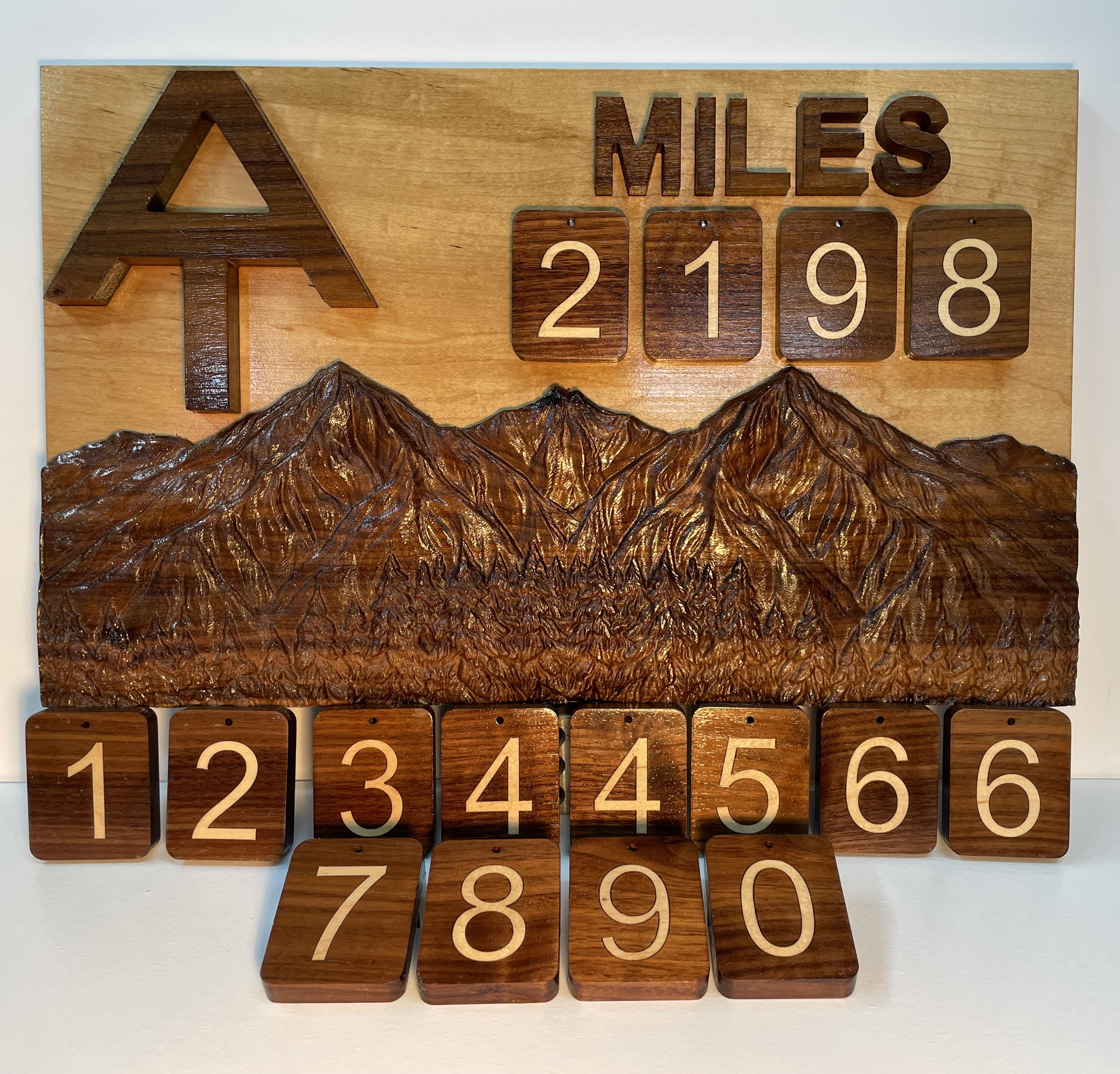
The AT logo and the word MiLES were done that way on this one from a couple of years ago. The numbers were done with the traditional inlay method.