I have a Frost 1/4 compression bit SC250. I use it for my contour cuts when I’m cut through material. The site says it’s recommended speed for solid wood is 9100mm/min at a depth per pass of .455in or roughly 11.5mm. I run it at 2500mm/min with a depth per pass of 3mm. Question is can the 5.1 Pro with 65mm spindle handle that high speed or are those speeds and feeds for industrial machines. I’d love to speed up my cut times across the board. Also can the mashine also handle IDC’s “Beast” at those speeds?
Such feeds and speeds are for heavy/industrial machines.
We sell two compression tools:
The Amana #46170-K .25" 2 flute compression cutter (numbered as #324)
which in hardwood is set at:

and the #214:
which may serve as a (quite conservative) starting point.
We do have a video series on feeds and speeds:
and our own Julien wrote up:
which should inform testing and arriving at settings suitable to your machine and selected material.
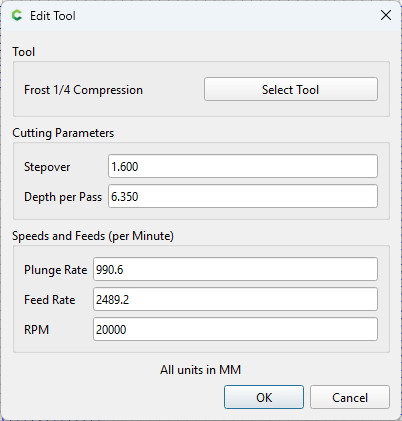
Using the above feeds and speeds article, I did my best at the formulas. Getting chipload, rpms, feedrate, DOC and WOC this i what I got.
And this is the result…
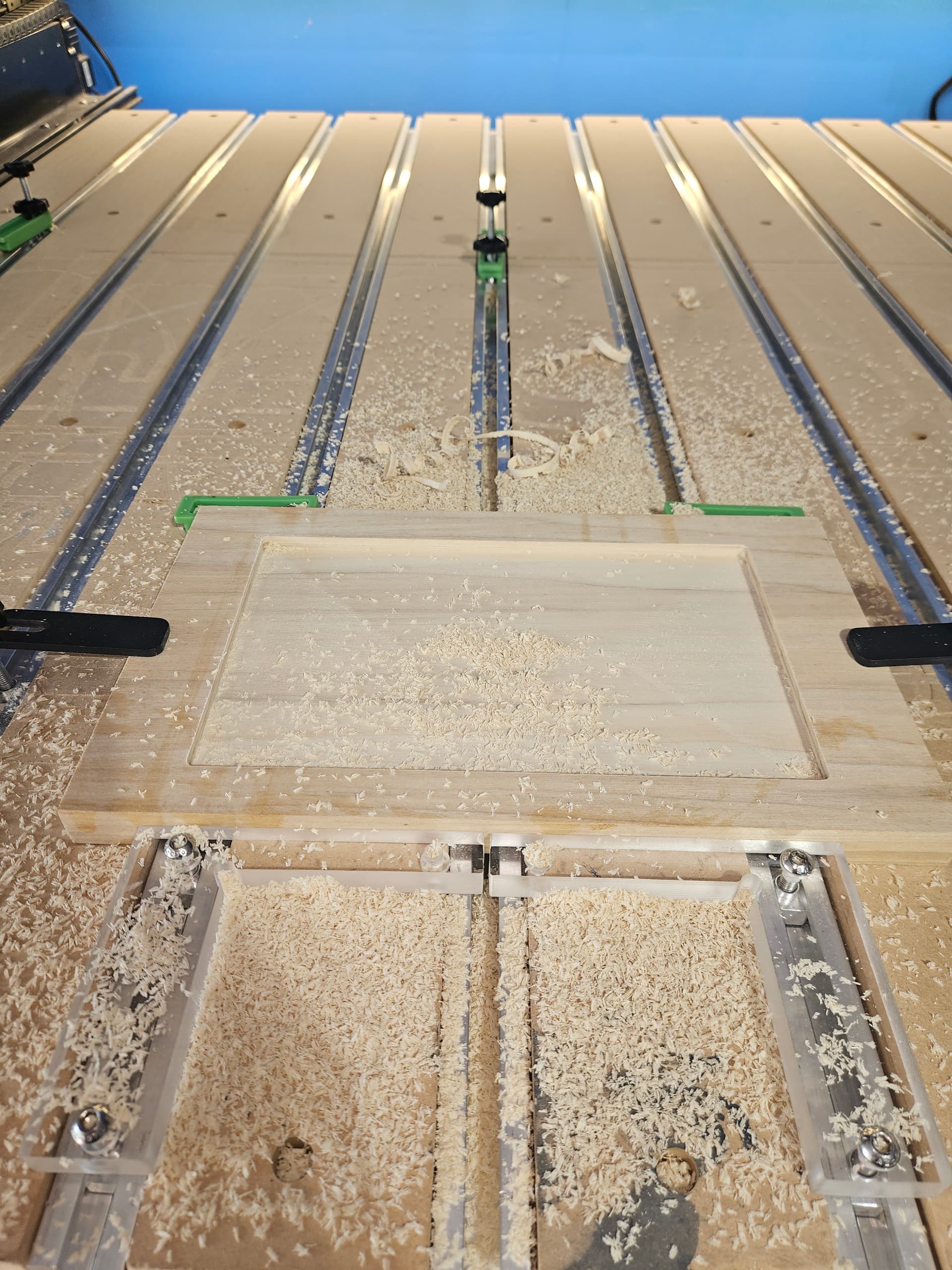
I think the test cut did well. The longer strips of wood…is that good, bad, or ugly? Any tweaks to my numbers above to improve?
1 Like
Chips are better than dust
1 Like
Looks good to me as a first test.
If stringing becomes a problem I usually either use a Facing or series of contour line toolpaths at 90 degrees to the wood grain for the roughing pass, then the finishing toolpath can be w/ the grain.
Long stringy wood cuttings can also be a result of the type of wood you are cutting. Pine and Oak can be stringy
1 Like
Hello. You asked about the IDC Beast. Running the 3/8" IDC Rougher ( the “Slayer” I can’t stand these names). With the 65mm ER-16 spindle on a 5.0 upgraded to 5.1 with leg kit. I do many pocket cuts like your photo in varied hardwoods. I posted some speeds few months back. Since the upgrade can safely run 2-3x faster in some woods due to massive vibration reduction.
My starting point for pockets with the 3/8 rougher bit is 50ipm plunge with .5" ramps 100ipm feed. Stepover 50% cut depth .25" (2/3rds ratio). On more cooperative woods I’ve run up to 200ipm. Alder I stay at 120ipm it makes the bit scream any faster. I do slabs with Mahogany substrate and Maple laminate top. Same for those, First pass cutting Maple at the minimum then 2nd and 3rd pass once the substrate is reached increase speed.
I’ve also started testing adding vectors to cut a starter “pocket within a pocket” to full depth in small passes because of the initial high slotting engagement. Then running the full pocket at deeper passes.
Hardwood is way too broad a category to follow a single formula. It varies massively species to species and board to board. I have dozens of slabs of equal size mahogany that range in weight from 8 to 13 pounds. The over 50% denser board can’t be run at same speeds as lighter . Perhaps with some 5kw or more spindle but certainly not with the 65mm spindle. Hope this helps.
1 Like
The relevant measurement is “Janka hardness” which as an average can be a useful guide:
1 Like
Janka hardness is a useful meaure but not a good predictor of wood machinability IME. Alder (alnus rubra) the example I gave has 30-50% lower Janka rating than several Mahoganies or Ash which machine easier. I have a thought that porosity is a factor - Alder like Maples has very fine diffuse porous structure - but have not dug into it.
For wood reference info I like Wood Database which pulls a huge swath of similar public data as CNC Cookbook with supporting anecdotal data from actual woodworkers.
2 Likes