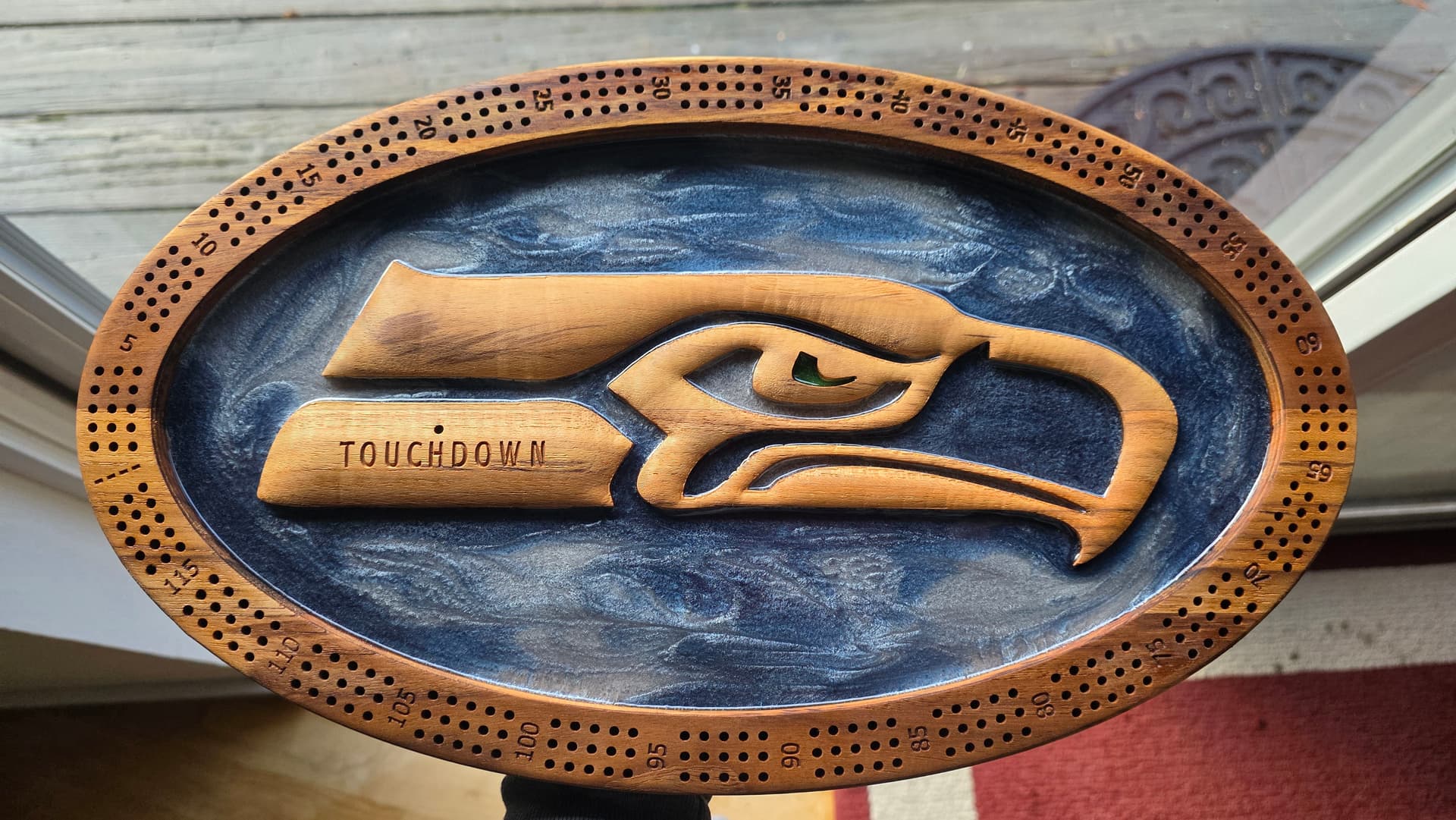
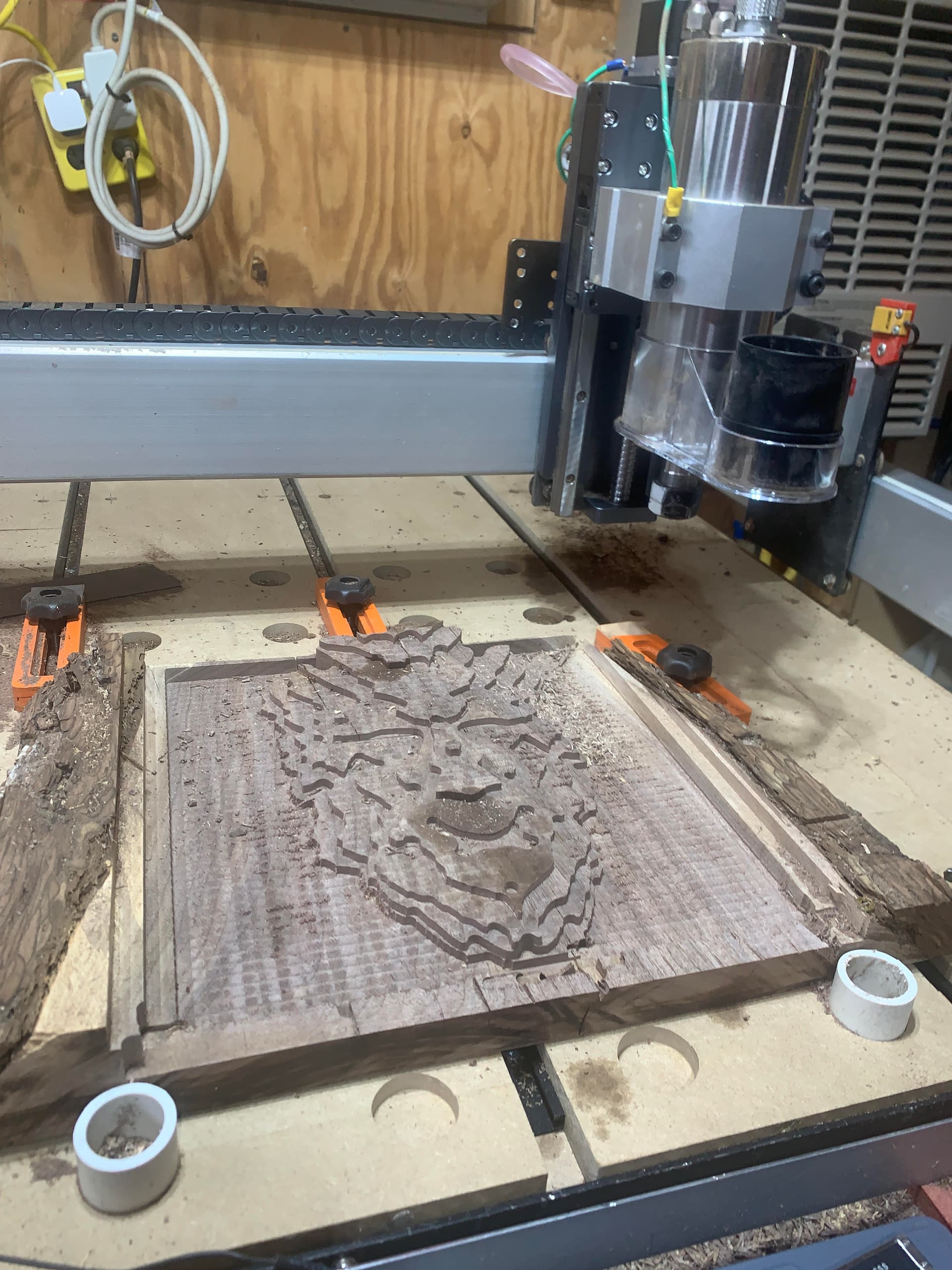
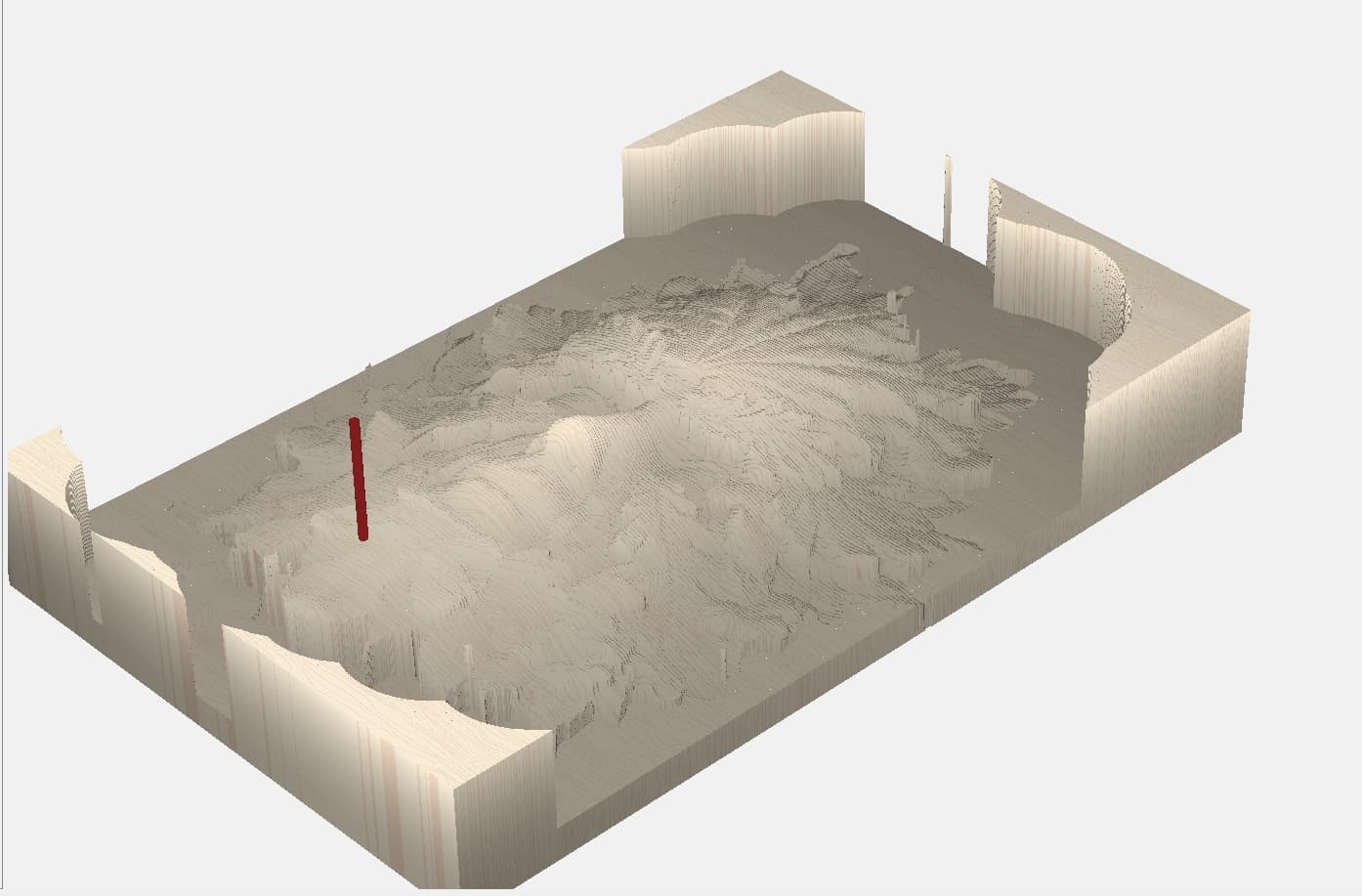
I’m working on my first 3d carving in Carbide Create Pro. I’ve completed my 3d rough in a rather thick piece of walnut, about 2" thick. Any suggestions on what endmill to use for finishing? I purchased the 101 but didn’t realize that it was so short. I’m worried that because of the height of this project the collet will hit the wood.
1 Like
Do a Google search for “Extra Long Shank ball nose end mill .125”.
That should bring up some options.
1 Like
Have you used their end mills? Quality ok?
Kodiak is generally well talked about. I’ve only ever used their long reach cutting tools on plastics and waxes myself.
There was nothing obviously wrong with my handful of tools, though it’s hard to evaluate real performance given my materials.
For my money, I’d give them a shot.
That said, if your sculpt has the clearance, a tapered ball will be much stronger at those lengths.
Keep in mind that you may not need a flute length as long as your material thickness. So something like the linked tool below with only 1” of flute length may be just fine if more than 1” of material is never cut at once and your shank never rubs on remaining stock.
Something like this is commonly used for 3d carving:
https://www.amanatool.com/46286-k-cnc-2d-and-3d-carving-3-6-deg-tapered-angle-ball-tip-1-8-dia-x-1-16-radius-x-1-x-1-4-shank-x-3-inch-long-x-3-flute-solid-carbide-up-cut-spiral-spektratm-extreme-tool-life-coated-router-bit.html
This is a strange one but looks interesting if there are clearance issues:
https://www.amanatool.com/46284-k-cnc-2d-and-3d-carving-1-deg-tapered-angle-ball-tip-x-1-8-dia-x-1-16-radius-x-1-1-2-x-1-4-shank-x-3-inch-long-x-3-flute-solid-carbide-up-cut-spiral-spektratm-extreme-tool-life-coated-router-bit.html
1 Like
If you put your 101 endmill in and jog around to the steep areas of the material with the spindle off you will see if it comes close to hitting.
1 Like
Just remember that CC does not model tapered ball nose bits, so your preview will not be as accurate. I’ve ruined a cut or two forgetting that. I’ve used the long reach Amana 46284, it does a good job. I’ve also learned to pocket around the edges of a design so as to leave clearance for the tapered shank.
2 Likes
I will try this. Thanks for the suggestion.
I’ve ordered the Kodiak. The Amana looks like a good bit to have in your arsenal but spendy. This has been a real learning curve. I’m embarrassed to say I’ve ruined a few end mills. At first I used a 1/32 for finishing on a shallower prototype piece and ended up smoking the project. I learned the hard way about creating a perimeter pocket for side clearance. Didn’t make my offset wide enough and got 90 minutes into the roughing pass and had to shut it down. I wish there was a way to restart a tool path from a certain time index.
Thanks for all the great feedback. I really like this forum.
1 Like
There is, this was added to Carbide Motion back in build 642:
New
First pass at program restart.
1 Like
My man, that’s nothing to be embarrassed about. I’ve got a small drawer labeled endmill graveyard precision dowels 
Every one is a lesson learned. Some are lessons learned a second time 
4 Likes
I would recommend using something like this:
https://www.amazon.com/SpeTool-Tapered-Cutting-Carving-Engraving/dp/B08FMBFGCY/
(there are many variations on that with different a tip radius (important: CC wants diameter so double the number!)
smaller tip radius == more detail but also a lot more machining time… so it’s a tradeoff.
for the size of work you seem to have I’d go for at least 1mm radius (2mm diameter)
for stepover, I’d pick between 10% and 25% of the diameter
(any more than that and you get little ridges)
the advantage of these tapered mills vs a straight one at the same diameter is that they’re stronger (pretty quickly up there’s a lot more metal vs a straight bit)
1 Like
I have had good results using the largest ball end mill first, then working my way down to smaller bits. A 3/4 ball end mill will clear most of the material. Follow up with 1/2 then 1/4.
A taper is good for small grooves, but leaves machine marks in my opinion.
1 Like
FWIW, I walk through this technique at:
I’ll try this technique. I don’t have a ball nose as big as 3/4. If I get one can I use it to carve bowls as well?
Will,
Any advantage to using ball nose on the roughing passes?
- Lee
The 3D rough is just removing the bulk of the material so using an endmill like a 201 or a.25" roughing endmill is the way to go. Using a ballnose for roughing passes will be a lot slower since it doesn’t remove as much material as a straight endmill. Using successively smaller ballnose endmills on the finishing passes gives you the detail of the 3D carve. Usually a 1/8" ballnose gets the required detail but if you want more detail you can step down in sizes until you reach the level of detail desired
Depends on the specifics of the 3D shape — if it’s rounded/organic, then the ball-nose should better conform.
I use Fusion so your options maybe different than mine.
I rough out the major material using a 3D pocket with a stock to leave of 0.010.
I then run the series of Ball end mills using a Scallop cut only because I find the machine marks usually don’t bother me as much.
The Scallop cut stepovers of .02 ( 3/4 ball ) , .01 ( 1/2 ball ) and so on.
There comes a point where it’s not worth running real small end mills unless you have serious knooks and crannies.
All operations are REST so I don’t get a lot of air cutting.
I am not sure if CC supports that approach .
One way or the other, you pay for bits.
Cheap parts don’t last long, so you have to replace them more often. Expensive bits last long, but you pay for them up front.
I am willing to spend the money on 3/16 end mills, .25 end mills, V-bits, and tapered ball nose bits.
I am not willing to spend the money on .125 or smaller bits. I just don’t use them enough.