I’m currently investigating adding CNC to my shop/garage (Shapeoko 5.1 Pro 2x2 w/65mm VFD 110V spindle) this is a hobby so hoping to keep things as low cost wise as possible, but definitely getting the best bang for my dollar.
All the 110v receipts in the shop are GFI which according to Carbide Create, you can’t plug 110V VFD spindle into, totally get that. I have read some of the posts on this site and some don’t encounter any issues and some do. So I’ thinking if this is an issue I need a plan or work around.
I do have (2) 220V outlets in my shop which is a plus, but will require routing heavy duty extension cord. Now first I really not interested in going to 80mm VFD spindle due to added expense, adding a chiller and me being a hobby woodworker. No Production type work.
So with that being said, I’m wondering what if I do route that heavy duty cord to the CNC. Then add 3000W Power Converter Step up/Step down portable unit and plug the 220v cord into the back of the unit. Then plug the 65mm VFD into one of the 110V outlets on the front of the unit, basically 220v is being stepped down to 110V. The unit has 15amp available current which works for the spindle which draws approx. 12amps. then I would plug the CNC controller into garage GFI with the shop vac. What I don’t know is how the spindle will perform on the converter, that makes me hesitant to go this route.
The other work around and probably the best way is to install stand alone 110 outlet for spindle only. Electrician expense is why I’m a little hesitant here. But In the long run may be the safe bet.
I want to put this out here to see other opinions, not looking for approval just if someone else may have tried this before or something I’m not seeing.
Apologize, for this wordy mess, hope its not to confusing. Thanks for any advise.
A VFD will definitely trip a GFCI outlet. When I installed the electricity in my shop most of the outlets are GFCI according to code. However I have several regular outlets for my Jet 1640 Lathe with a VFD. Because of limited space in my breaker box I put the GFCI outlet in the first box in each run. The GFCI breakers are double wide and take up valuable space. If your GFCI outlets are in the outlets simply remove the GFCI and replace with a regular outlet. If it is breakers then maybe replace the GFCI breaker with a regular one. Replacing the GFCI outlet and/or breaker is a DIY project if you kill the mains coming into your shop. If you are not comfortable then get an electrician. The step down option is an expensive one. The other issue with a step down outlet is current draw. If you have a 30 or 60 amp 220 outlet a short circuit may never pop the breaker. You should match the breaker to the outlet rated voltage and amperage. Running a larger breaker than is required could be risky.
The 110V outlet which is at the CNC is GFCI outlet and two additional regular outlets on the same circuit are spaced 2 to 3 feet apart like what you would see above kitchen counter top. I know they’re same circuit because when I flip the breaker all receptacles go dead.
The breaker in the b-box is not GFCI.
I’m definitely no electrician, but I’m thinking, if I was to simply plug into one of the regular outlets then I won’t be inducing a GFCI issue to the VFD spindle.
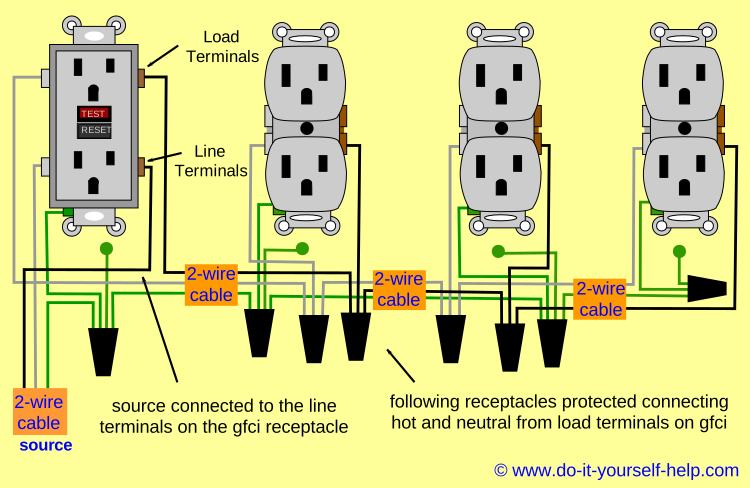
Usually if the first outlet is GFCI the whole branch is GFCI. You can try it but if it does not work then just replace the GFCI outlet with a standard one. The purpose of the first outlet in a branch being GFCi is to protect the other outlets on the branch.
What Jim & Guy said… If the first outlet is the one you’ll use for the CNC, move the GFCI outlet to the second outlet. It will still protect the rest of the outlets.
Please note that any modification needs to be done per electrical code in your locale, but further note that some localities allow for a dedicated single plug outlet in a garage.
Lastly, in some instances a better quality GFCI outlet has worked for some folks on support.
I had to deal with plugging my trailer mounted fairground organ with a VFD controlled variable speed blower into outlets I had no control over. After a lot of trials and tribulations what finally worked was to install a big isolation transformer in line between the outlet and the VFD. I used one found on Amazon for a couple hundred bucks. Depending on your jurisdiction’s code version 240 V outlets may now also require GFI in garages and outbuildings, so going with a 240V circuit may not solve the legal problem.
In my shop I just installed a non-GFI outlet. So far the police have not shown up. (Actually the wiring predates that particular code requirement, so retrofitting with GFI was not a requirement.) My shop is neither a wet nor damp location so I don’t think there is any actual safety issue beyond that posed by most household wiring.
I just did this same thing. I had a 220 - 20 amp outlet that i converted to 2 120 volt circuits. I changed the 220 receptacle to a twist lock so it wouldn’t get unplugged by mistake but that’s not necessary. I have a 4 wire chord using the 2 hots a neutral and a ground. From there I ran to a double pole switch as a kill switch for my whole system (CNC, computer, light, VFD ect.) I then ran it to 2 duplex outlet boxes with 2 receptacles in each box. Each receptacle box used a different hot leg and they both shared the neutral. It works just fine as long as the breaker is a 220 double pole. Hope this makes sense!
220V power usually means the receptacle has 2 hot(110V) conductors & not using a neutral. It may be possible to easily convert it to 110V if there’s a neutral conductor in the box - one hot, one neutral = 110V power.
I had a sub panel installed along with 3 independent GFCI outlets 2 years ago in my shop and the spindle/vfd upgrade I installed would trip it. I just replaced it with a standard outlet and it’s been great.
“The correct action is not to have a GFCI free outlet but to filter out the high frequency component which is triggering the GFCI. Fit a proper filters. Or buy a VFD with proper integrated filtering.”
Why?
Long before the tech for GFCI’s was available we were using outlets without them. They were implemented to reduce potential electrical shock associated with water sources. Most building codes implemented them by directing installations within 3’ of a water source. This initial code change morphed into “all” circuits being required to have a GFCI installed in residential homes in most municipalities code requirement.
Yes, they provide a safety factor when installed. However, standard GFCI’s that you purchase at the big box stores work very well. Meaning they trip at a much lower threshold than designed and leave a circuit unusable. I know this for a fact based on the amount of them I have had to replace and ultimately remove from some circuits that that when tested with different test devices showed no actual ground on the circuit and continuity checks were sat. These circuits were not powering any VFD’s, in fact appliances/power tools pulling less than 5 amps on a 15 amp circuit would trip the GFCI. The same appliance/tools were used for extended periods of time with no actual tripping of the circuit breaker in the circuit itself.
I’m not arguing the design and implementation of a GFCI to perform a safety function. I don’t believe they should be required to be installed into each circuit in a residential home when a water source is not involved. To tell everyone they should spend hundreds or even thousands of dollars to allow the use of a circuit that is crippled by a $20 outlet does not make sense to me either.
In some cases, the GFCI is NOT used to protect the downstream receptacles…they each may have their own, dedicated, GFCI - which, if you’re not on a budget, some folks do in order to eliminate issues when one thing triggers the GFCI, and you have the rest of the circuit die. You can tell by seeing if the receptacles that are downstream turn off when you press the TEST button your GFCI.
If they are protected, you’ll need to basically swap the GFCI receptacle for the next non-GFCI receptacle down the circuit…and plug your CNC into the first one.
In my area (Westchester, NY), code has been updated to REQUIRE a 20V GFCI protected receptacle per car bay of your garage. This is because electric car recharging cables are becoming a more and more popular addition to garages. That doesn’t mean you can’t have other non-GFCI receptacles in the bays…so running a dedicated outlet is likely going to be OK. Don’t run anything other than the CNC VFC on it to avoid the possibility of an incident you don’t intend.
If you’re not handy with electrical stuff - it’s going to be worth the money to have a licensed electrician from your area - familiar with your codes - to do the work.
The reason why, is the same reason we wear seatbelts in cars. It is the best way to protect people. A car can be built without seatbelts or they can be removed… Then people get injured, it goes to court and then you end up with annoying things like stickers on your rear view mirrors warning people to take care when relying on mirrors.
It is not responsible to tell people to stop using safety devices and those that do could end up in court.
Let’s face the reality, this problem exists because most VFD manufacturers are cutting corners and putting little or no filtering in to save a buck or two.
Spending a couple of extra bucks on a filter is way cheaper than a hospital bill or worse.
The solution does not have to be expensive. Heck most cheap VFDs even have the space to put the components back in which were skipped in the factory.
I never said it was responsible for someone to say stop using a safety device? This was clearly stated in the first sentence of the last paragraph of my post.
My comment was why someone should have to spend more $ out of their pocket to be able to use a circuit with a GFCI in it when the design of the GFCI was to mitigate potential water hazards and the migration of GFCI’s are no longer restricted to their intended purpose for a specified distance?
The “ reality” of this is tech has changed for what type of appliance can be used on a circuit and the manufactures have not evolved with this tech to develop a GFCI than can be used for the average consume with the newer tech.
My post was to ask a question, not start an argument.
Been there done that. Spent many 10’s of hours and close to a thousand bucks on various devices purported to provide appropriate filtering and shielding. Had electrical engineers consult on the problem. No (or very little) joy. Some of the solutions provided some relief, none solved the problem reasonably consistently until I added the 60 pounds of transformer in addition to the shielded cables and RF chokes. I’m not an EE, so I can’t pretend to explain it, just trying to follow the advice of people who worry about this sort of thing for a living.
It would have probably been easier if I could have controlled the quality of the outlets I was plugging into, but I couldn’t.
I could argue that one or two trips a day that just cause the music to stop playing is not a big deal. Power outages while running a machine with a good size spinning bit cutting an expensive piece of wood are a bigger problem
For what it’s worth I have seen inspectors in some locations disallow a plug but insist the cord be hardwired to the wall. In this case the end user paid for the professional work twice. To be clear the electrician did what was ordered by the end user by the hour and was not there for the inspection.
GFCIs operate correctly. Fitting a filter for $ is not having to spend more, rather it is just mopping up what VFD manufacturers have not sold/included in the first place. Go ask them why they didn’t offer a better product for a few extra $ (answer: because most of this stuff is made in China and it is a race to the bottom on price).
 (Actually the wiring predates that particular code requirement, so retrofitting with GFI was not a requirement.) My shop is neither a wet nor damp location so I don’t think there is any actual safety issue beyond that posed by most household wiring.