That really is impressive. and that’s while cutting with a compact router.
Couple of questions: 1) how large was the table top you were building this on? I read back… 72"x72" 2) if you don’t mind me asking, what was your cost? 3) I see where your power pendant is. Where do you have your controller and PC for running CM? Are they enclosed to protect them from dust? 4) How is your dust collection system outside the enclosure?
Finally: Do you have any plans drawn up for this? Seems like a really straightforward design. I really like it!
Cost is somewhere between $1000 and $1500 dollars which honestly was the most shocking part. My boss was more concerned about the noise levels than the cost. I also used nicer plywood for it. If I was building this for myself I would have probably used cheap plywood or even OSB and just sanded / painted it. I was honestly hoping for an even lower dB level but am very happy with the results.
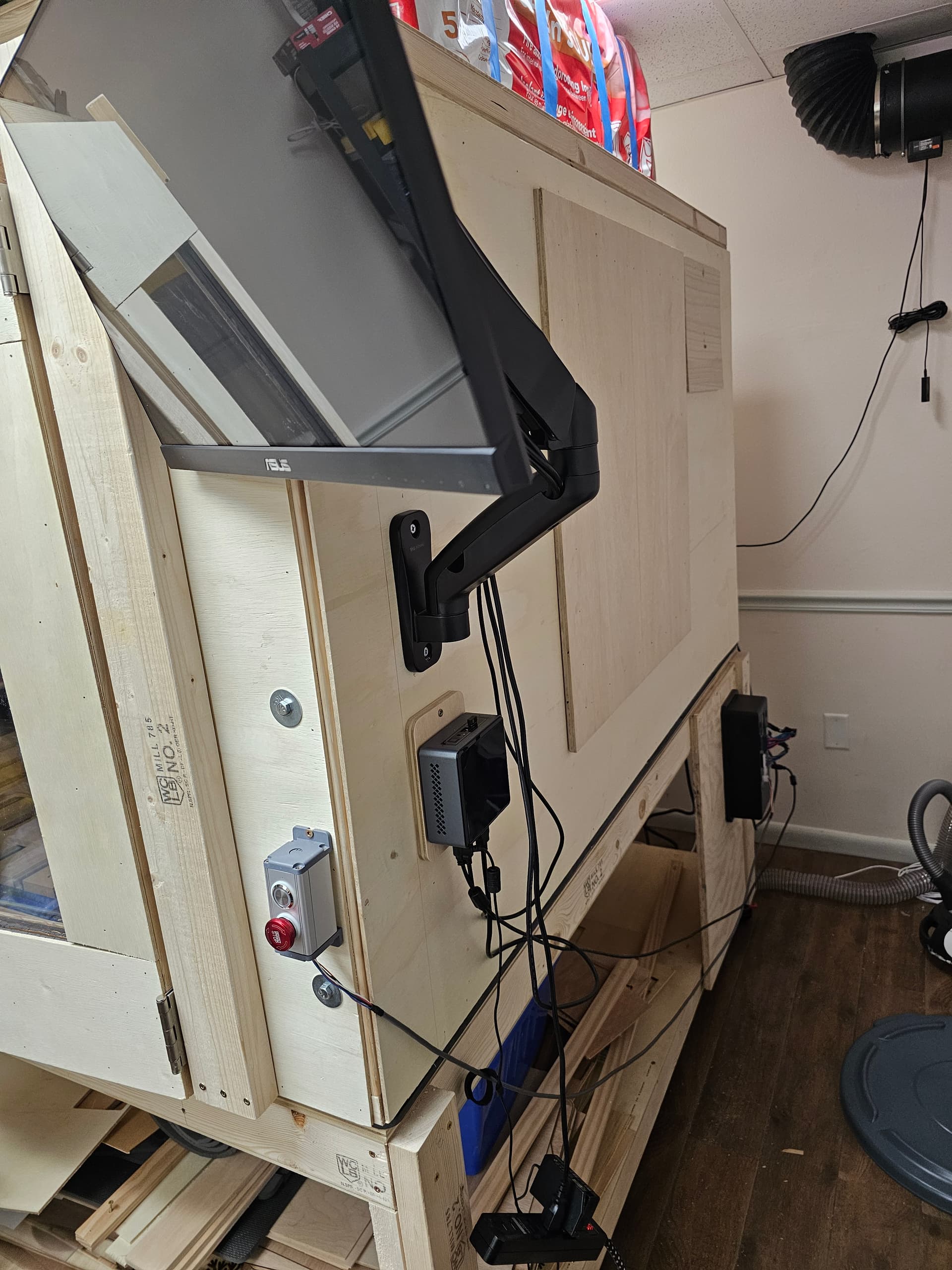
The Warthog electronics are attached to a piece of scrap plywood that is bolted to the back right table leg. I added a monitor arm to the side near the front for a touch screen monitor and below that an old Intel NUC PC for controlling the thing. The USB cord from the Warthog runs over to that.
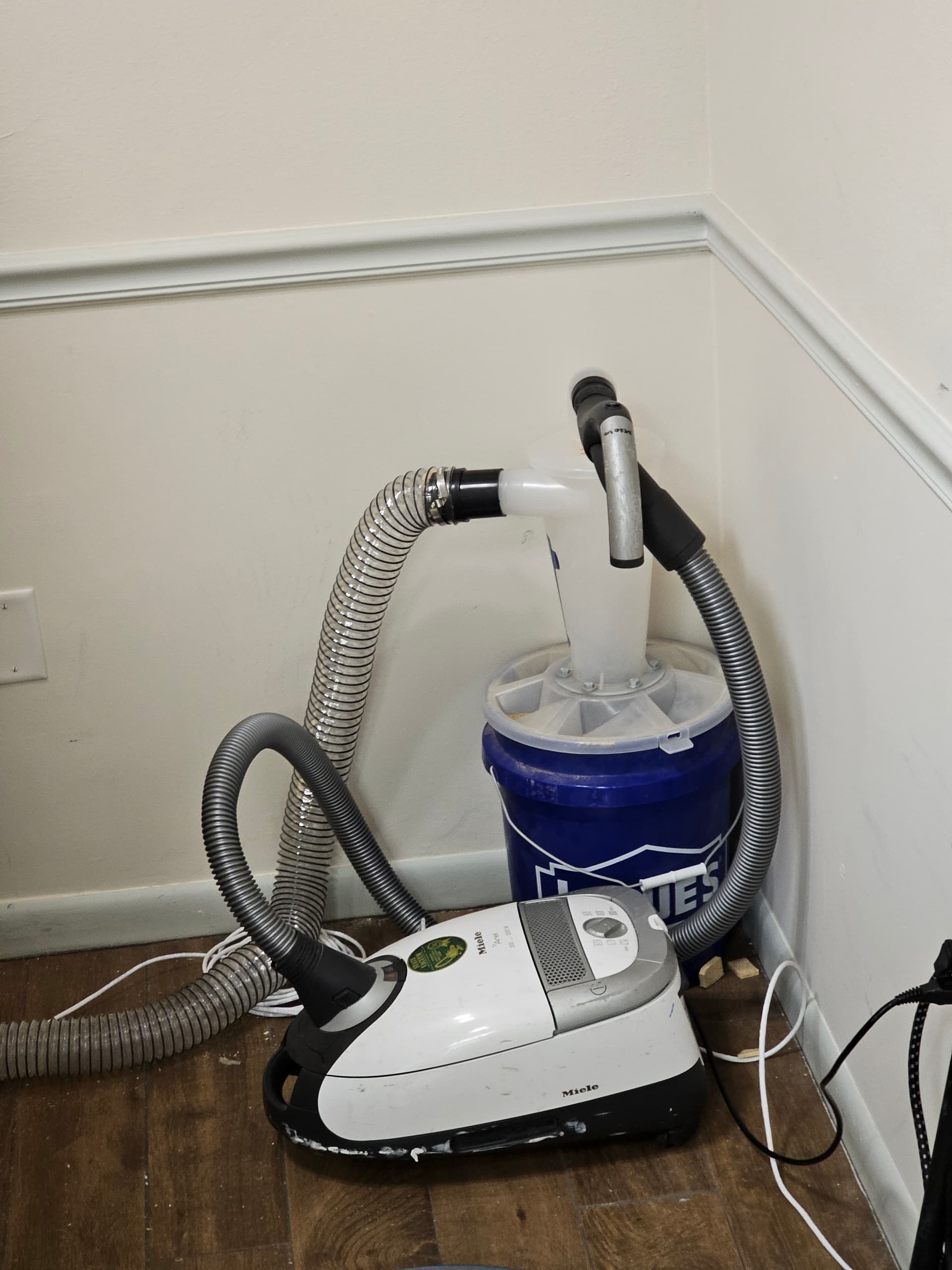
Dust collection is just an Oneida Deputy Cyclone on a 5 gallon bucket for now. That is probably going to get upgraded to a 55 gallon drum when I have time. I am using an old Miele vacuum with that. Miele vacuums are quiet by design. They have a second impeller on their exhaust that bumps the frequencies up into the ultrasound range. You can get them used on ebay for like $150 dollars. They also have a suction adjustment on them so you can dial in the amount of suction you use. Their lowest setting is still enough to clear saw dust and it is super quiet. They are also considered a high end vacuum, they last a very long time, and are designed to be serviced.
I have a Fusion 360 model for the table. I did not model the enclosure because I really had to design it on the fly after the S5 Pro arrived. Things like the placement of the access hatches and the location of the dust hose support arm had to be changed after the fact. Most of the construction is just standard house framing with some augmentations so it can be taken apart. There are also a number of mistakes like the how the doors are mounted. They attach to a 2x4 which is then screwed to the top and bottom of the front wall. This is because I forgot to put supports on the inside for the doors to screw into.
I should also point out that it is not complete yet. I still need to build the air intake and exhaust ducts. Right now there is thin plywood covering those holes. I also want to somehow add a switch for turning the router on an off without having to open the doors. Big issue there is that because this is a commercial building I have to make sure it meets very tight fire codes.
You might as well get a vfd spindle if youre already investing in that much to reduce the noise as rob pointed out that you had a compact router. The difference is night and day.
If you end up looking at a HuanYang for the VFD, beware they speak a slighly modified Modbus which you need to mess about with the Modbus library to successfully communicate with.
There are some nicer ones out there for a bit more money from the likes of Delta which offer vector control for more stable speed and presumably talk real Modbus.
I was looking at the Rockwell Automation offerings. They are highly recommended on the r/PLC subreddit and it looks like they have support for Ethernet through addon modules.
I’ve not use the Rockwell / Allen Bradley VFDs so can’t speak to them.
A ‘native’ Ethernet module might be nice, but look carefully to check whether it supports any protocol more recent than Woodstock, many of these devices say “Ethernet IP” but really mean Modbus TCP over Ethernet and you’ll end up with a Modbus library to talk to it anyway, in which case plugging an Arduino into the Modbus serial might be just as easy. If you want to send control commands to the VFD over this then talking to it on hardwire and serial may be preferable.
Aha yes, that’s good for real time and critical control too, and a bit more civilised than Feldbus or Modbus.
Be careful though, there are many toys to buy if you start down this road, Moxa make lovely switches and router / firewalls suitable for real time control applications…
 2) if you don’t mind me asking, what was your cost? 3) I see where your power pendant is. Where do you have your controller and PC for running CM? Are they enclosed to protect them from dust? 4) How is your dust collection system outside the enclosure?