Shapeoko 5 Rigidity

Context:
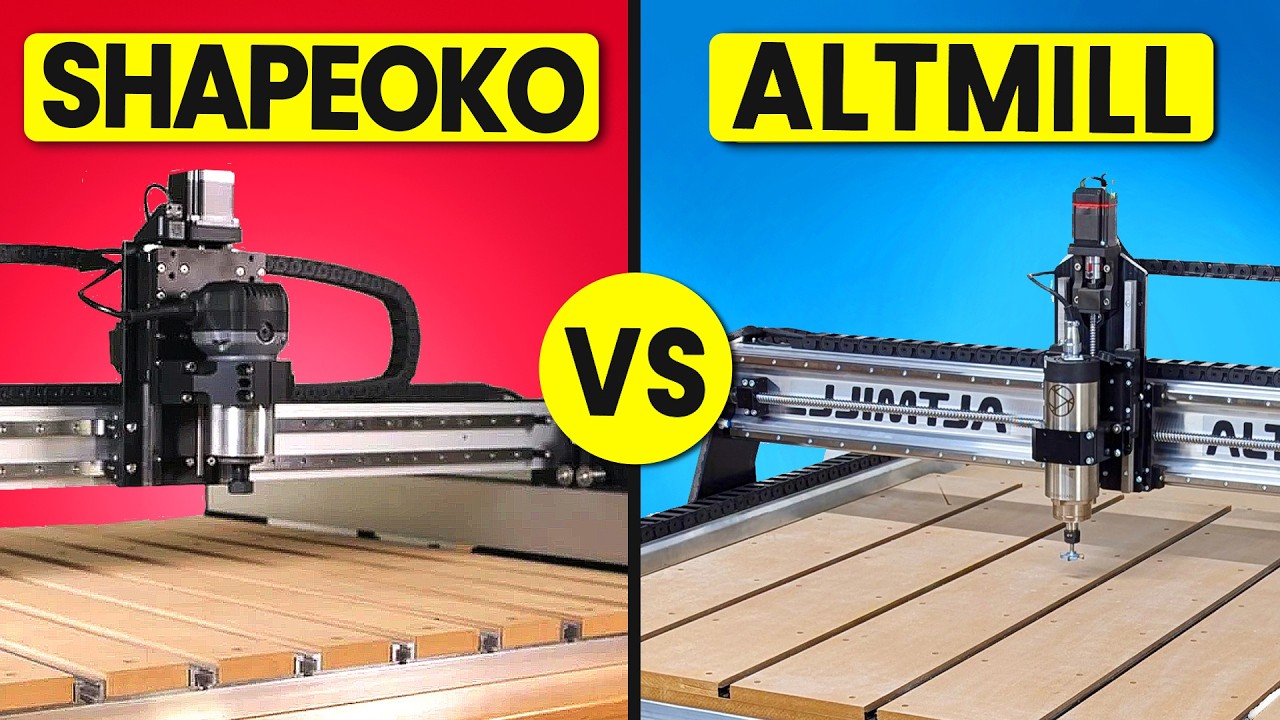
I’ve come across this CIC video which compares the Shapeoko 5 vs the Altmill and, at this time-stamped link I’ve provided below for a couple mines, he does a quick rigidity ‘test’. He shows the amount of movement on the Shapeoko 5 when pulled on, showing it to deviate a significant amount more than the altmill.

He also mentions the motor size differences, that the shapeoko is inferior for that reason.

He also does a v-carve cut ‘race’ at 60ipm feed and plunge on both - illustrating the shapeoko to be slower. I believe it may be simply because he either: a) included the shapeoko bit length measurement in the time or used Carbide Create for shapeoko’s file and another software for the altmill’s file.

Question:
Mainly, I just wanted to get other peoples input on the Shapeoko 5’s rigidity: their opinions on this video’s veracity, if what he’s showing is fair around rigidity (or if he just had not tightened certain screws enough), and if I should have my perspective swayed or not in any way.

thanks

2 Likes

I don’t have any context regarding the machines themselves but I’m a big +1 for the community and support around Carbide 3D (disclaimer, I’m super biased as I spend a decent amount of time on the forums :sweat_smile:)

Regardless, I’d recommend posting the same question on the relevant altmill forums if you haven’t. Just to see if there are any material differences in the communities :slightly_smiling_face:

3 Likes

Influencers gonna influence. That’s what they are paid for.

6 Likes

I haven’t heard or read about anybody twisting a Pro 5 frame. You do have to tighten the frame bolts ( how do I know that ? :stuck_out_tongue_winking_eye:)

lol you know what I meaaannn based on the play in the z-axis gantry shown in the time-stamped video

I’ll chime-in. The Altmill actually looks like a good machine. I may be biased towards C3D, but it can’t be denied that on cost and features, I consider the Altmill the best competitor. It looks to be a great package and you probably get a good machine either way. Looks like a mostly well thought-out video. I would like to see more like precision and bed rigidity investigated. I’ll try to point out some areas for more info more so than disparage any brand. In all good competition is good for us consumers in this case.

Differing Features: To further the complexity of the equation, the Altmill doesn’t have a bed, BitSetter style solution, workholding, etc, so it is less ready to run. You have to figure that out and pay for it separately. Rigidity is nothing without workholding…seriously the hybrid bed is peak workholding for functionality and versatility. So that changes the cost equation, useability, and how much time it takes to get it running at first. I will also note that I HATE those tall work clamps he’s using on the Altmill for CNC work. Those things are great for an assembly table, but are a danger to endmills. :smiley:

Rigidity: The Altmill does look to have a taller X gantry extrusion. That does help in twisting. But I would also like to see how they do in lateral and longitudinal deflection on the motion system. Twisting is likely the more limiting factor in the motion system though. The base extrusions are also taller and that helps. But I would like to see the deflection of the bed. Both areas of deflection are very important. C3D has both longitudinal and lateral support on the bed. He does not test bed deflection in the video.

Motors: One factor this video doesn’t take into account is the ballscrew pitch. The steppers may have more holding power/torque, but the ballscrew pitch comes into play when you’re factoring in actual torque. Looking at the Altmill ballscrew (I’m just going by what I can see in the video, as they do not have specs) ballscrews, they look to be a coarser pitch. So that means that it sacrifices torque at the ballnut and precision in exchange for speed. I can’t say that’s huge, but it is a factor in how much torque there is at the actual cut and not just at the motors. The closed loop is nice, but from what I have seen, it does less than most people think it does. I could be wrong there.

V-Carve Race: It’s been hit on, but unless the software is apples to apples, it’s a moot comparison. Is the retract height and speed the same for instance? The difference is that C3D has a free design/programming solution, Altmill doesn’t. In a real world v-carve you usually have a tool change. The Altmill not having that and needing a Z reset would add real world time that the BitSetter greatly simplifies.

Cost: He didn’t add in the cost of the bed, extrusions, wasteboard slats, and clamps to the Altmill, all of which comes with the S5Pro. Again, a CNC and it’s rigidity are useless unless you can actually hold the material in place. A Baltic birch sheet for the bed runs ~$140 where I live. A sheet of MDF is ~$50 at Lowe’s. Powertech extrusions would be ~$85 for 8 of them that are 48" long. The clamps he’s using (again, I hate those for CNC work) are ~$30 for a 4-pack. So that is an additional ~$305 to add to the Altmill physical cost in his own comparison. If you also factor in a license of Vectric VCarve Pro (so you can use the whole bed of the machine as the base version only lets you cut 24"x24"), you’re adding another $700 to be able to use the Altmill at all unless you find a free program, and those have less features than Carbide Create. For the table cost on my S5Pro 4x4, I personally went overboard with a Rockler Rock-Steady bench frame and two butcher block style pieces for the top. I think I’m in $500-ish on that. And a Windows tablet is $300-ish. So they are pretty much a wash-ish depending on your load out. A S5Pro table could be built for a whole lot less than I spent. So all factors considered, the price I would say is a wash, or actually in favor of the S5Pro. But it’s not far off either way.

Beer: I guess I’m pickier there. :smiley: I will pass on bad free beer. :stuck_out_tongue:

Edit: Grammar because it’s been 35 years since elementary school. :smiley:
14 Likes

I greatly appreciate the time and effort you put into that answer mate. Very thorough.

3 Likes

I researched machines extensively prior to purchasing my S5Pro 4x4. There are numerous reason I chose C3D, it best fit my intended use/requirements for my first cnc.

This community was one of them.

5 Likes

Additional info: I just went out to my shop and replicated this as well as I can. But I added a pull scale and a dial indicator because science. :slight_smile: Adam Savage says the difference between play and science is writing stuff down. I will add that it is also measurement.

I have a S5Pro with the 80mm spindle. So the only difference is a larger spindle. But it connects to the Z axis in the same way, so how it changes the results is minimal if anything. I chucked up a 0.250" tooling pin in the collet (the one that came with my BitZero) and Crush-It clamped a dial indicator to the bed.

Pulling upwards like he did with what I am 1,000% sure is the same amount of force I got about 0.015" of sideways deflection. We look about the same size, but I fear he’s in better shape as my tummy looks bigger. :smiley: Using the pull scale with 50 lbs of force forward on the tooling pin, I got about half that in deflection at the tip of the tooling pin at a length that most 1/4" endmills are set to. While none is best, that’s way better than I saw with any of the previous generation of Shapeokos and likely most machines in the class (coughOFcough). The upward deflection would only come into play for plunging operations. The side deflection felt like more force and I think is more pertinent to more operations

As far as the source of what is likely more deflection I think it’s 2 things:

A - The X linear rails are farther apart and that is less rigid for that direction of force. I don’t think this is the biggest contributor though. I think this size was done to get a custom and thick extrusion that is capable of being UPS shipped…contributing to the ability to ship for free.

B - I think this is the main one: the connection of the X gantry to the Y linear rails. The S5Pro has some intricate assemblies that allow the use of the Y shift (to be 100% over the bed, or have a front overhang for long pieces like edge joinery). This means the X gantry bolts to those Y assemblies in the narrower dimension. Whereas the Altmill has larger plates that connect the X to the Y in a more robust way.

Conclusion: The deflection is not much in most real world scenarios IMHO. But I believe it is the extra feature of the gantry shift that is the root. Personally I like the gantry shift and have used it a few times on some aluminum extrusion that was pretty tall.

6 Likes

@tobwhy

Just curious… to what end are you asking the original question… curiosity? Or something else. I see that you have a shapeoko already. Are you looking to purchase an additional CNC? Upgrade to a new CNC and get rid of your current one? Again… just curiosity.

1 Like

I don’t suppose you would be willing to share a short clip of what you are describing, would you? It sounds great, just i’m having a little trouble picturing it :slight_smile:

Yeah, pretty much I am a shapeoko pro user and currently wanting to upgrade. The pro did me well compared to the MPCNC I had originally but I find myself in a position where the belt system keeps skipping steps because I’m trying to push harder to get production times down, but I’ve hit a wall on peak how hard I can push it even after meticulously optimising: CAD design, toolpath design, and endmill design. There’s not really any clear alternative paths left to pursue to get around the fact I need a more robust machine.

I’m using 1/8 and 1/16" bits that have to do 2-3 DoC passes instead of just 1. It can cut the full DoC in one pass from past attempts great but, by the time it gets to the tool change, the machine has skipped steps in the x-axis and the next tool mildly wrecks what was just done as a result. I’ve had a quick go at belt tightening but it seems to always end up back where it was by the time i’ve fully tightened the clip back onto the extrusion. Perhaps I need to be more tough with it…

Since I know it can be done but it just needs a bit more OOMPH behind it, I’m asking around. Its been a few years since my purchase so I ask Q’s to reassure my perspective on the machine’s performance relative to the competition these days. The reduced noise on 80mm water cooled spindle now i’m moving toward production stuff is also important to me now i’ll potentially be exposed to it on a more continuous basis.

Also because delivery to the UK is $621 and import taxes are $800 (so an extra $1400 on the cost), that additional expense over just the standard cost of goods makes me want to ask a bunch of these question to keep justifying the purchase of shapeoko, on balance compared to the comp., to myself lol (cry more). We don’t have any companies like shapeoko/OF/Altmill in the UK that are competitive

2 Likes

Ultimately you have to make the decision on which machine you will purchase. I have the S5 Pro 4x4 with the 65mm spindle (ER-11). I have not researched machines since purchase of Nov 2024. There were numerous reasons I went the C3D route as a first time cnc owner. The fact that the entire machine came as a package (Hardware/software) was high on the list. I did not want to have to gather materials for the bed/spoil board etc. If I wanted to piece together a machine (spoil board/software etc.) I would have gone with AVID CNC.

The economical side is an ever changing landscape unfortunately and based on recent cross continent economy fluctuations I went ahead and acquired a 3D printer that I have been researching for almost a year.

That said, I have not experienced deflection that I can routinely measure on my wood projects. I will at some point get into some small brass and aluminum projects. The 65mm spindle is a completely different animal since I stepped up to 8mm and 5/16” diameter bits. I’m not running a business, hobbyist only and understand each persons needs are different. Th S5 Pro satisfies my current needs well beyond my current proficiency in CAD. Where my efficiency gain has really provided an advantage is making router templates on the cnc and then using them on material up to 12/4 with a handheld router. Yes I could do this on the cnc even if tiling was needed. However, with the template I’m not constrained to specific geometries that fit on the 4x4 and for larger projects its just faster to set and clamp a template and make a run around it with a spiral compression bit.

Good luck on your quest, I don’t envy your journey!!

1 Like

I don’t visit forum on a regular basis however when I was doing my research on machines in order to choose the one I would purchase I watched many videos and read many reviews on Altmill and the Shapeoko 5 Pro. I noticed that the Altmill appeared to move more quickly from job start to first plunge and from plunge to plunge but for me that wasn’t a deal breaker because I wanted to buy from a company that reviewers noted the best support. I’m very pleased with C3D and support has been there for me every step of the way. Being a retired engineer I have posed some pretty in depth questions to support and they haven’t disappointed me with the answers I get. The 5 Pro is a rigid platform. I know because I’ve put it to the test by stalling the drives many times during my learning curve. The only issue I’ve found is in the design of the cross beam to Y axis mounting system used. I feel steel dowel pins or a slotted mounting design should have been used to add skewing resistance when a jam happens but because two servos in a synchronous drive are used the cross beam is always moving them same distance on each side even if both sides aren’t matched at the rear end limit. As long as the spring loaded end limit switches are tripped at initialization the controller thinks all is ok. Just loosen the mounting bolts and re-align the cross beam to square and check that the end limit switches don’t push the beam out of square again before tightening the mounting bolts. All in all the 5 Pro is a very good platform for a machine that isn’t rated as a commercial level machine. By the way, as far as speed I just found out that acceleration speed in baked into the firmware in the controller and this I’m told is set to the maximum speed that the designers feel the machine can safely run. It may not be as fast others but I’ve seen mine move in the high 200 ipm’s between plunges.

A couple of things to check.

  1. Have you checked the belt tension? If it’s anywhere near target range, it’s not causing missed steps, that’s the stepper motors running out of holding torque. The ballscrews on the newer machines will likely eliminate the missing steps for you as they gear down so much.

  2. Regarding shipping to the UK, I got my old SO3 from Robotshop, seems they have the 5 Pro now too https://uk.robotshop.com/products/carbide-3d-shapeoko-5-pro-4x4-cnc-router?qd=fd71f7fbeef969223d77905ad5c3ccd4

HTH

1 Like

I own a Shapeoko 3XXL with their spindle. Customer service was great as is this forum. I was a gant’s ass from buying a 5 pro. I bought an Altmill because I thought it offered more value than the CC mill. I could be wrong. I do miss the bit setter. You can still use Carbide Create with an altmill. You can also use F360. You dont need to buy a Vectric product. As far as the bed goes…a sheet of MDF was 50 dollars and 8 pieces of 48" t rack on Amazon was 68 dollars. Altmill has more options for add ons. I bought a vortex with mine and will buy a bit changer as soon as they are available. I saw the CIC video and the movement was not the reason I did not but another CC mill. That to me seems pointless…I really kinda hated not buying another CC product. I just got the new mill and may hate my decision later but what is done is done. I can say this without a second thought…I looked a a Onefinity mill too…not in a million years would I but a product from this company and that is based on how I was treated on their forums. With all that said, I would stiil buy from Carbide Create.

2 Likes

I use Carbide Create as it is the only one that will run on a M1 Mac. $120 a year. I pass the Gcode file through GSender on an Intel iMac to Genmitsu 4040 PRO MAX. Everything works fine. I have ordered the Altmill 2X4. The Main reason is, I don’t have to build a table and I already had the Mac computers so that didn’t add to the cost.

1 Like

The comparison leaves out many concerns. 1. Product support, parts and guidance as to operations. 2. durability and machine life 3. replacements parts
With these lacking any point leaves you with a machine as a boat anchor. Tom

1 Like

Altmill must be funding these influencers heavily. You can tell if you watch any of these guys that trash Onefinity now but used to be the greatest thing on earth before. Also CLC did a horrible presentation of the Shapeoko on the live he did. Was totally unprepared and was disappointing how he looked like a rookie trying to work a machine. Saying how great it was then later trashing it when comparing to Altmill. I believe they are all capable machines just need to represent them properly and when comparing you need to include all of the things that the 5 pro includes. I’m on my 3rd different Shapeoko because they work amazing and customer support has taken care of every single issue I have come across even if it was my fault including replacing the main black box that I broke…

1 Like

I bought the shapeoko 5. It is officially done :rofl:

7 Likes