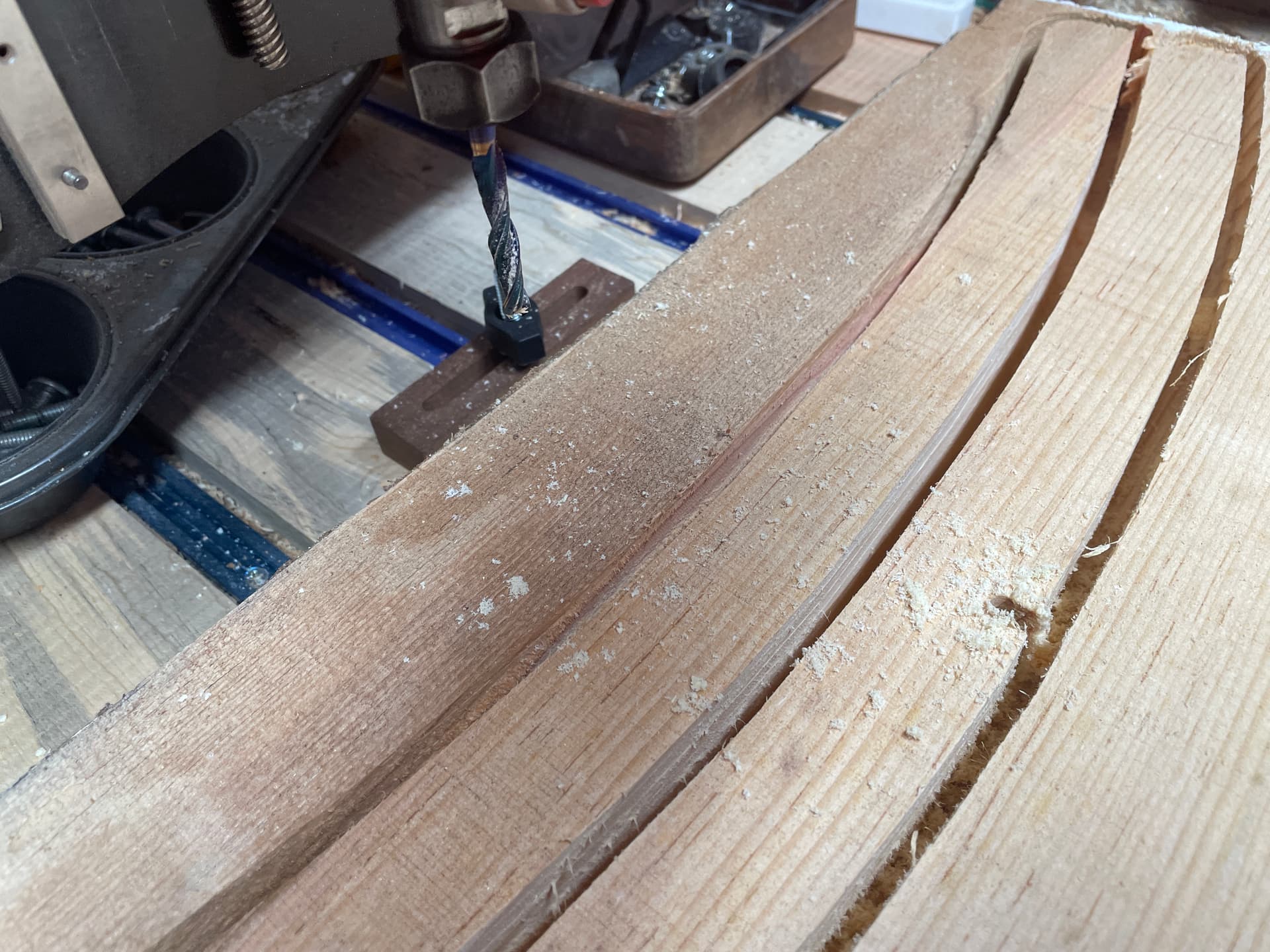
Well here I go again. Haven’t wanted to use my Longmill for cuts I’ve used in the past. Thought I’d fire up and try a new approach to my outdoor chair components. Cutting my components from 2 inch moist material from a file I’ve used my times. The file is from Carbide Create Pro, saved to gcode and launched with gSender. 1st component successful, .187 dept per pass, 35 plunge rate, 70 ipm, total depth 1.5", 8 minutes of cut time. 2nd component (only difference is 80 ipm) get approx 3/4" in depth halfway down one side and plunges north to Alaska shutting down the router. I raise the Z and select jog to XY zero, it’s way off. Rotate the model in the gSender workspace to see if there is there is a path for the plunge, nothing on screen.
I hesitate to voice a theory, but I’m wondering if a Longmill Mk2 (with a Makita for a spindle) and a sharp bit can and does run off into the woods when the step motors experience to much stress? Personally I didn’t graduate from University in Engineering with a minor in gcode to be able to decode the file where this took place. And honestly my survival instincts tell me the gcode is not the problem because the first component was successful.
I’m going to post this on the Sienci Forum as well and in the end I’m going to accept if this machine should only be used for light topical carving and not for cutting deep components even and slow/er speeds. Image attached.
The tool path is an “Outline” as opposed to a “Pocket” and the components are aligned horizontally so that space between them is space between them is 1/4"(+ 10-15%). Mechanical interference? I’m looking around for culprits but seriously I don’t see any.
The bottom half of my vacuum dust fitting isn’t shown in my photo. When in place it does a good job of evacuating. However I will say in wet wood as in todays cutting I chase the carriage with a 90 degree pick and pluck it out so the bit doesn’t have to cut back through the debris. I use an upcut bit when making these cuts and still quite a lot of dust stays behind.
Is my theory about torque and the machine running off unlikely?
The Longmill is an open-loop control system - same as C3D’s lineup. So any lost steps are simply unknown to the controller.
Lost steps can be caused by binding in the mechanics, pushing too fast thru material, or poor electrical connections between controller & motors - or all three. Sometimes vac hoses put strain on motor connections & cause them to glitch… Sometimes it can be machine vibrations that cause it. If you bend/strain your motor connectors while jogging the axis, you can quickly tell if the connector is a problem - it will cause stalling/grinding/ reverse direction.